
Tetris, created in the early 1980s, originated from arcade game designs that focus on simple yet engaging block mechanics. You manipulate falling shapes within a grid, competing against time or others in fast-paced play. Its straightforward mechanics and competitive nature made it a hit in arcades worldwide. As you explore further, you’ll discover how this classic game’s blend of simplicity and challenge continues to influence modern puzzle and multiplayer games.
Key Takeaways
- Tetris was created in 1984 by Alexey Pajitnov in the Soviet Union, originally as a computer puzzle game.
- Its simple block mechanics made it ideal for arcade adaptations, leading to widespread arcade releases.
- Arcade versions featured competitive gameplay, encouraging players to outscore opponents or clear lines faster.
- Tetris’s arcade origins popularized real-time multiplayer play, fostering social competition in arcades.
- Its success established Tetris as a foundational arcade and puzzle game, influencing future multiplayer and puzzle game designs.
Have you ever wondered how a simple puzzle game like Tetris became a global arcade phenomenon? It all starts with its clever block mechanics. When you play Tetris, you quickly realize that the game isn’t just about fitting shapes together; it’s about mastering how these blocks move, rotate, and fit into the grid. Each tetromino, or block shape, has specific ways it can be manipulated, creating a dynamic challenge that requires quick thinking and precise control. This system of block mechanics allows for endless variations in gameplay, keeping players engaged and constantly pushing their limits. You get better at spotting patterns, predicting how blocks will fall, and planning your moves ahead of time. The simplicity of the shapes combined with the complexity of their placement is what makes Tetris so addictive. It’s easy to pick up, but difficult to master, which fuels its universal appeal.
Now, as you dive deeper into the game, you’ll notice that competitive gameplay is a core element that helped catapult Tetris beyond casual play. In arcade settings, players didn’t just compete against the computer—they competed against each other in real-time or through high score challenges. The thrill of beating a friend’s score or surviving longer than others created a sense of urgency and excitement. The game’s design encourages quick decision-making, which becomes even more intense in competitive scenarios. You find yourself racing against time, trying to clear lines faster and prevent the stack from reaching the top. This competitive aspect fosters a social atmosphere in arcades, making Tetris more than just a solitary puzzle—it’s a test of skill and nerves against other players. The push to achieve higher scores or survive longer adds layers of motivation, turning simple block mechanics into a fierce contest of reflexes and strategy.
In arcades, Tetris’s appeal grew because it seamlessly combined these elements—intricate block mechanics that challenge your spatial reasoning, and competitive gameplay that sparks rivalry and motivation. It’s not just about solving puzzles; it’s about doing so faster and better than everyone else. The game’s ability to adapt to different skill levels kept players coming back, enthusiastic to improve. That blend of accessible mechanics and competitive edge is what made Tetris an enduring arcade classic. Even today, you can see its influence in countless puzzle and multiplayer games, all rooted in those fundamental principles of block mechanics and competitive gameplay. Tetris’s success proves that simple ideas, when executed well, can become timeless entertainment.

My Arcade Tetris Gamer V: Tetris Game preloaded with 200 Bonus Games, Arcade Classics
Officialy Licensed: This is an officially licensed Tetris title, ensuring an authentic gaming experience. Includes 200 bonus games!!!
As an affiliate, we earn on qualifying purchases.
As an affiliate, we earn on qualifying purchases.
Frequently Asked Questions
Who Created the Original Tetris Game?
You should know that Alexey Pajitnov created the original Tetris game. He designed it with innovative puzzle mechanics and game design principles that make it so addictive. Pajitnov’s focus on fitting shapes together seamlessly, combined with simple yet challenging gameplay, set the foundation for Tetris’s success. His creativity revolutionized puzzle mechanics, making Tetris a timeless classic enjoyed worldwide.
What Inspired the Design of Tetris’s Falling Blocks?
You’re curious about what inspired the design of Tetris’s falling blocks, right? The game’s creator was influenced by geometric shapes, which are simple, familiar forms that could be easily recognized and manipulated. These shapes fit well with the gameplay mechanics, encouraging players to arrange and rotate them efficiently. The idea was to create a puzzle that’s both challenging and intuitive, making the geometric shapes central to the game’s addictive appeal.
When Was Tetris First Released in Arcades?
You’re curious about Tetris’s arcade debut, and it first hit arcades in 1988, a pivotal moment in game design and arcade history. Like a spark igniting a fire, its release captivated players worldwide. Developed by Alexey Pajitnov, this puzzle game’s simple yet addictive mechanics transformed arcade gaming, leaving a lasting legacy. Its debut marked a milestone, blending innovation and fun in a way that still influences game design today.
Which Arcade Machines First Featured Tetris?
You’ll find Tetris first appeared on arcade machines like the Elektronika 60 in 1984 and later on arcade platforms such as the Tengen version in 1988. In arcade history, these machines showcased the game’s simple yet addictive mechanics, enthralling players worldwide. You experience the core game mechanics—fitting falling blocks into complete lines—making Tetris a timeless classic that shaped arcade gaming and influenced future puzzle games.
How Did Tetris Influence Other Puzzle Games?
You see, Tetris revolutionized puzzle games with its innovative block design and simple yet addictive gameplay mechanics. It set a new standard, inspiring developers to create games that emphasize pattern recognition and quick decision-making. Its influence is evident in titles like Dr. Mario and Puyo Puyo, which adopt similar mechanics. By doing so, Tetris shaped the evolution of puzzle gaming, encouraging endless creativity and strategic thinking.
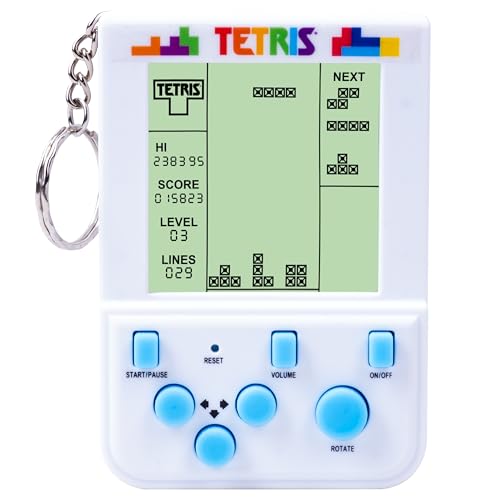
Tetris Keyring Handheld Arcade Game – Officially Licensed Mini Retro Console with LCD Screen, Sounds & 2 Game Modes – Portable Classic Puzzle Toy, Travel Gift, Retro Gamer. Officially Licensed.
Portable Retro Gaming Anywhere – Take classic puzzle action on the go with the Tetris Keyring Handheld Arcade…
As an affiliate, we earn on qualifying purchases.
As an affiliate, we earn on qualifying purchases.
Conclusion
Just like a masterful puzzle solver, you now see how Tetris’s arcade roots shaped a gaming legacy. Its origins are the seeds from which a global phenomenon grew, turning simple shapes into a symphony of strategy and quick thinking. As you play today, remember you’re part of that timeless dance—an intricate puzzle that continues to challenge and inspire. Tetris isn’t just a game; it’s an ever-evolving mosaic of arcade history and innovation.

My Arcade Tetris Pocket Player Pro: Strategic Puzzle Games, Portable Game, Tetris Game, 2.75" Full Color Display
Officialy Licensed: This is an officially licensed Tetris title, ensuring an authentic gaming experience
As an affiliate, we earn on qualifying purchases.
As an affiliate, we earn on qualifying purchases.
My Arcade Tetris Gamer V: Tetris Game preloaded with 200 Bonus Games, Arcade Classics
Officialy Licensed: This is an officially licensed Tetris title, ensuring an authentic gaming experience. Includes 200 bonus games!!!
As an affiliate, we earn on qualifying purchases.
As an affiliate, we earn on qualifying purchases.