
Snooker is a strategic cue sport played on a large table with 21 balls, including reds and colors. You take turns potting balls in a specific sequence, earning points for each successful shot, with safety plays to block your opponent. Mastering the game involves precise shot-making, positioning, and planning your moves carefully. As you learn the rules and tactics, you’ll discover how skill and strategy combine to make snooker an exciting challenge—continue to explore more about its gameplay and techniques.
Key Takeaways
- Snooker is played on a 12×6 ft table with 15 reds and 6 colored balls, scored by potting in sequence.
- Players take turns potting reds (1 point each), then colored balls (worth 2-7 points), with strategic shot selection.
- Mastering cue control and positioning is essential for setting up future shots and maximizing points.
- Safety plays are crucial to hinder opponents’ options and gain strategic advantages during the game.
- Understanding game rules, scoring, and match tactics enhances both skill and strategic decision-making.
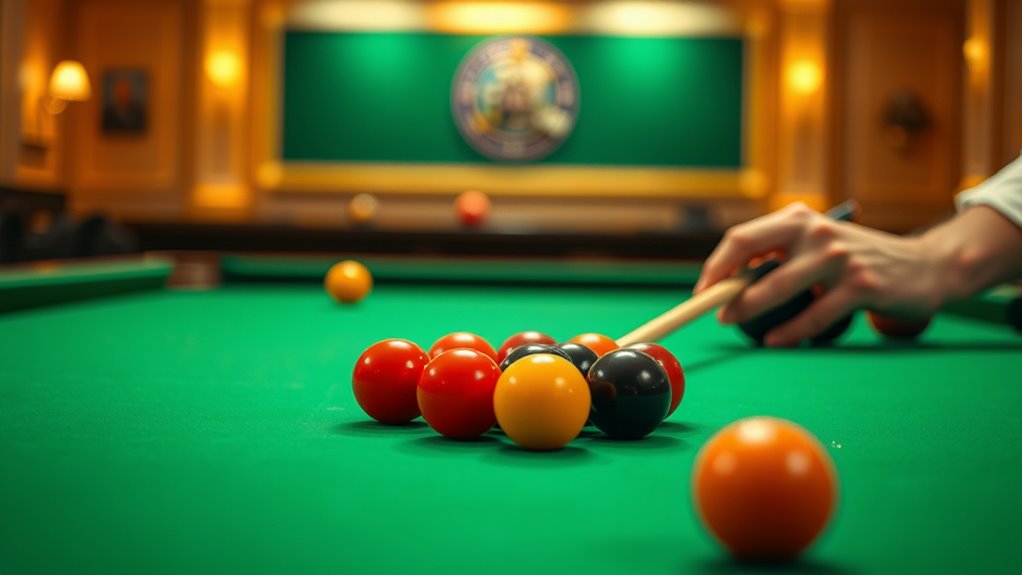
Have you ever wondered what makes snooker such an exciting and strategic game? To truly appreciate it, you should understand its history overview and equipment essentials. Snooker originated in the late 19th century in British India, where British Army officers played billiards on a modified table. Over time, the game evolved into its own distinct sport, gaining popularity across the UK and eventually worldwide. Today, snooker boasts a rich history filled with legendary players and iconic tournaments, solidifying its status as a game of skill, patience, and strategy.
Getting familiar with the equipment essentials is essential if you want to play or understand the game better. The standard snooker table measures 12 feet by 6 feet, covered with a green cloth called baize, which provides a smooth surface for the balls to roll. You’ll need 21 balls—15 red balls worth one point each, six colored balls worth varying points (yellow, green, brown, blue, pink, and black), and a cue stick. The cue is fundamental for striking the balls, and its quality can greatly influence your performance. Properly maintained, a good cue provides accuracy and control, enabling you to execute precise shots and strategic plays.
As you start playing or watching snooker, you’ll notice that the game combines skillful shot-making with tactical thinking. The rules are straightforward: players take turns trying to pot balls into designated pockets, earning points based on the value of each ball. Reds are worth a point each, and after potting a red, you must then pot a colored ball, which is returned to its spot unless it’s the last in the frame. The colored balls are worth more points, with the black ball being the highest at seven points. The game continues until all reds and colors are potted, and the player with the most points wins. Mastering the game also involves understanding match formats, which can influence your overall strategy and approach.
Strategy plays an important role, especially when planning your next move. You need to take into account not only how to pot a ball but also how to leave yourself in a good position for subsequent shots. This involves careful positioning, controlling the cue ball’s movement, and sometimes playing safety shots to make your opponent’s turn more difficult. Mastering these tactics requires practice, patience, and a deep understanding of the game’s rules.

HomeSeason Snooker Cue Stick 18oz 1/2 Jointed 57in Pool Cue, with Extension Leatherette Cue Bag, Durable Ash Wood Billiards Cue
🔥Cue Stick Material: Crafted with selective ash wood and precious purplehear wood splicing, connected with high-quality copper joints,…
As an affiliate, we earn on qualifying purchases.
As an affiliate, we earn on qualifying purchases.
Frequently Asked Questions
How Did Snooker Originate and Develop Over Time?
You discover that snooker originated in the late 19th century in India, evolving from billiards. Its history evolution saw it becoming popular among British Army officers, shaping its modern rules. Over time, the game gained cultural influence worldwide, especially in the UK and Commonwealth countries. Tournaments and professional players boosted its popularity, making snooker a globally recognized sport. Its development reflects a rich blend of tradition, skill, and international appeal.
What Equipment Is Essential to Start Playing Snooker?
To start playing snooker, you need essential equipment: a snooker cue and a set of snooker balls. The cue is your primary tool for striking, while the balls, including reds, yellows, greens, browns, blues, pinks, and blacks, create the colorful puzzle on the table. Together, they set the stage for strategic play, blending precision with skill, transforming simple objects into a game of clever shots and tactical thinking.
Are There Different Variations of Snooker Played Worldwide?
Yes, there are different variants of snooker played worldwide. You might come across snooker variants like American snooker, which has shorter tables and different rules, or British and international rules that vary slightly in scoring and fouls. These variations reflect regional preferences and traditions, so when you play abroad, verify which snooker variants are in use to confirm you’re following the correct international rules and playing your best.
How Do Professional Snooker Players Train and Prepare?
You immerse yourself in intense practice routines and mental conditioning to sharpen your skills. You spend hours perfecting your stroke, focusing on consistency and precision, while also engaging in visualization techniques to boost concentration. Regularly analyzing your gameplay helps identify areas for improvement. By balancing physical drills with mental exercises, you build resilience and focus, ensuring you’re always ready to perform at your best during high-pressure moments.
What Are Common Mistakes Beginners Make in Snooker?
As a beginner, you often struggle with cue ball control, causing awkward shots and missed opportunities. Foul management is also tricky, leading to unnecessary penalties. To improve, focus on steadying your stance, practicing precise cueing, and maintaining control over the cue ball. Avoid rushing your shots, and always plan your next move. With consistent practice, you’ll develop better cue ball control and minimize fouls, boosting your overall game.

NIANRONGHUA 22 Pcs Snooker Ball Standard Set 2-1/16 inch – 52.5 mm Billiard Balls Set Suitable for Official Game Ball/British Billiard
You Will Receive: 22 PCS snooker balls set Includes 15 red balls, 1 Black, 1 Blue, 1 Pink,…
As an affiliate, we earn on qualifying purchases.
As an affiliate, we earn on qualifying purchases.
Conclusion
Think of snooker as a delicate dance on a green battlefield, where every shot is a step toward victory. Mastering the rules and strategies helps you stay in rhythm and outsmart your opponent. With practice, you’ll develop the finesse to weave through tricky situations and control the game. Remember, each shot is a brushstroke on your masterpiece. Keep honing your skills, and soon you’ll be painting your own winning story on the snooker table.

VIBRANTIA Pro Pool Cue Chalk, Tournament Standard Billiard Chalk, 12 Cubes/Box with Travel Storage Box,Low Dust, Super Dense, Suitable for Snooker/Pool/8-Ball
1. Core Function: Essential for Billiards Designed specifically for billiards, this chalk applies smoothly to cue tips to…
As an affiliate, we earn on qualifying purchases.
As an affiliate, we earn on qualifying purchases.

Pool Table Cover 8ft – Billiard Table Cover, 600D Waterproof Covers for Billiard Pool Table, Heavy Duty Scratched-Free UV Protection Snooker Furniture Table Cover – 8 Feet
Pool Table-Fit Cover for 8ft || 100L x 56W x8H inch (254L x 142W x 20H cm) universal…
As an affiliate, we earn on qualifying purchases.
As an affiliate, we earn on qualifying purchases.