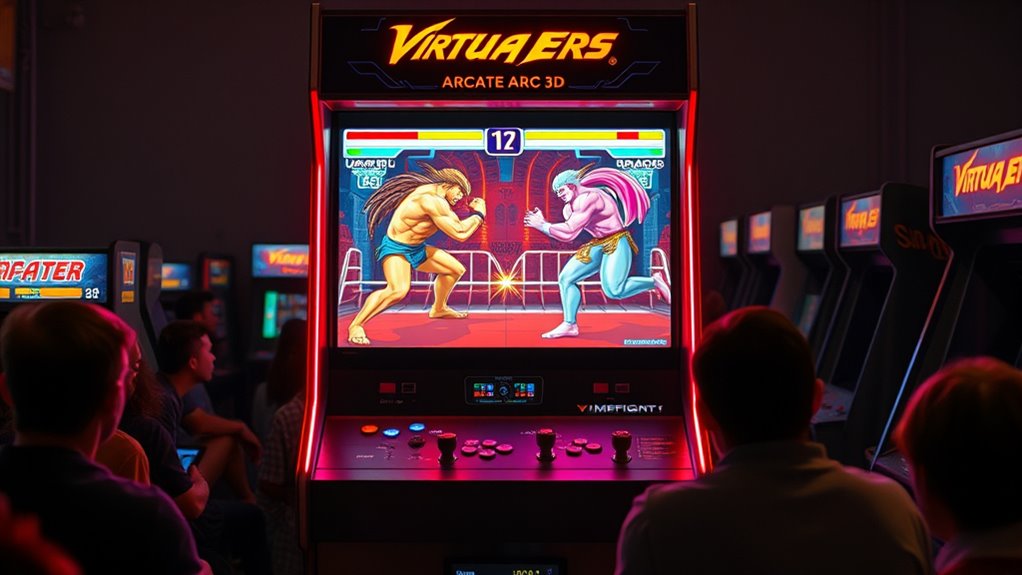
Virtua Fighter revolutionized arcades by being the first to introduce fully 3D fighting gameplay, allowing you to move in any direction and attack from multiple angles. This breakthrough not only made matches more dynamic and strategic but also changed arcade design and social interactions around competitive play. The innovative mechanics and visuals set new standards for arcade entertainment, paving the way for future 3D fighters. Keep exploring to discover how this game shaped the fighting genre forever.
Key Takeaways
- Virtua Fighter was the first arcade game to fully implement 3D gameplay, transforming fighting game mechanics.
- It introduced free movement and sidestepping, allowing attacks from multiple angles.
- The game featured advanced graphics and fluid animations, enhancing realism and immersion.
- Virtua Fighter influenced arcade design, increasing social interaction and competitive play.
- It set a new standard for fighting games, paving the way for future 3D titles in arcades.

When Virtua Fighter debuted in arcades, it revolutionized the fighting game genre by introducing fully three-dimensional gameplay. This was a game-changer, shifting away from traditional 2D fighters and allowing you to move freely in a 360-degree space. The movement innovation was immediately noticeable—you could sidestep, circle your opponent, and perform attacks from angles that weren’t possible before. This level of control made matches more dynamic and realistic, elevating the arcade experience to new heights. As a result, Virtua Fighter became the catalyst for an arcade revolution, inspiring developers and players alike to rethink what fighting games could be.
You could now approach fights with a new sense of strategy. No longer confined to a flat plane, you learned to use the three-dimensional environment to your advantage. Dodging and sidestepping became essential tactics, adding layers of depth to combat that players previously only dreamed of. The game’s fluid animations and precise controls made every move feel natural and responsive, making each fight more engaging and immersive. This movement innovation set Virtua Fighter apart from its 2D predecessors and pushed the entire arcade scene toward embracing 3D technology.
The arcade revolution triggered by Virtua Fighter didn’t stop at gameplay mechanics. It also influenced the design and layout of arcades themselves. With the need for more advanced hardware to support 3D graphics, arcade cabinets became larger and more sophisticated. Players felt like they were stepping into a new dimension, and this technological leap drew crowds enthusiastic to experience the future of gaming firsthand. The social aspect of arcades was amplified as players gathered around to watch high-level matches, exchanging strategies and marveling at the game’s realism. Virtua Fighter’s success proved that the arcade audience craved innovation and was ready for the next evolution in fighting games.
This movement innovation wasn’t just a technical achievement; it reshaped how fighting games were played and appreciated. You now had to master not only your character’s moves but also how to navigate the three-dimensional space effectively. The skill ceiling was raised, and the competitive scene grew more intense. Virtua Fighter’s influence persisted, setting a new standard for arcade entertainment and paving the way for future 3D fighters. Its impact on the arcade revolution is undeniable—transforming the genre and mesmerizing players with a fully 3D gameplay approach.
Frequently Asked Questions
How Did Virtua Fighter Influence Future 3D Fighting Games?
You see, Virtua Fighter revolutionized future 3D fighting games by pioneering realistic character modeling and fluid motion capture. It set a standard for smooth animations and lifelike combat, inspiring developers to refine character movements and create more immersive experiences. Its success proved that detailed 3D environments and precise motion capture could elevate gameplay, encouraging other games to adopt similar techniques and push the genre forward.
What Were the Technical Challenges in Developing 3D Arcade Hardware?
You faced a tall order when developing 3D arcade hardware, as hardware limitations pushed you to innovate with rendering techniques that balanced performance and visual quality. You had to tackle challenges like real-time 3D rendering, smooth character animation, and managing processing power within tight constraints. This meant constantly optimizing hardware to prevent lag and maintain fluid gameplay, proving that sometimes you need to think outside the box to get the job done.
How Did Players Initially React to the 3D Gameplay?
You likely felt initial excitement when experiencing 3D gameplay, but some players also expressed skepticism about its new mechanics. The shift to 3D fighting brought a fresh, immersive experience that captivated many, yet others hesitated, unsure if it could match traditional 2D fighters’ depth. Overall, reactions were mixed, with enthusiasm driving the genre forward despite lingering doubts, paving the way for future innovations in arcade gaming.
Who Were the Main Developers Behind Virtua Fighter’s Creation?
You’ll find that Yu Suzuki and Sega AM2 led the development of Virtua Fighter, pioneering hardware innovation in arcade gaming. With a team of talented developers collaborating closely, they created a groundbreaking 3D fighting game that revolutionized the genre. notably, Virtua Fighter’s success helped Sega capture over 50% of the arcade market share in 1993, showcasing how their innovative approach and teamwork changed the industry landscape forever.
What Are the Lasting Impacts of Virtua Fighter on Arcade Gaming?
Virtua Fighter profoundly impacted arcade design and player engagement by pioneering 3D fighting mechanics, making gameplay more immersive and realistic. You’ll notice its influence in the way arcades evolved to include more dynamic displays and interactive setups. This game drew players in with strategic depth and fluid animations, setting a new standard that continues to shape fighting games and arcade experiences today, ensuring long-lasting appeal and innovation.
Conclusion
You step into the arcade and suddenly feel like you’ve entered a whole new universe—virtually unstoppable. Virtua Fighter doesn’t just change the game; it transforms you into a 3D fighting legend, making every punch and kick feel like a blockbuster showdown. Thanks to this groundbreaking innovation, arcade battles become epic battles of mythic proportions. Get ready to release your inner champion and conquer the digital arena—because once you start playing, there’s no turning back!