TL;DR

Play games on Amazon Luna for your game nights, included with Prime
- A rotating selection of games, no download needed
- Play on TV, laptop or phone
- Fast, free delivery for your gear, too
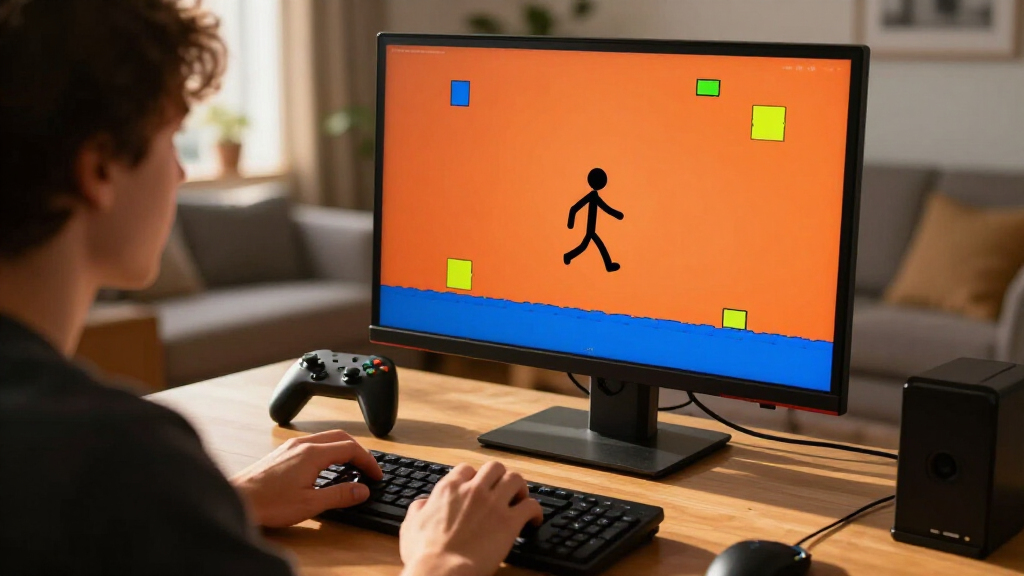
A developer reports that an AI model, Claude Opus 5.5, built a complete browser-based ‘Stickman Arcade’ — a rhythm brawler called BEATDOWN plus eight more games and an animation tool — in a single working day, according to the original account. The project contains roughly 24,500 lines of dependency-free JavaScript, with all art and audio generated by code. The account comes from a single first-person blog post and has not been independently verified.
A developer writing under the Thorsten Meyer AI byline reports that an AI model built an entire browser-based Stickman Arcade — a rhythm-driven fighting game called BEATDOWN, eight additional games and a stick-figure animation tool — in a single day, without the author writing any code. According to the post, the project comprises roughly 24,500 lines of plain JavaScript with zero dependencies, with every visual and sound generated by code rather than image or audio files. The claim, published in a first-person account, has not been independently verified, but it illustrates how quickly AI coding tools can now produce complete, playable software from a loose creative brief.
The developer says the project began with a deliberately open-ended instruction to the AI: make its own stickman game, not a clone and not a tutorial project. The model — identified as Claude (Opus 5.5), built by Anthropic — responded with BEATDOWN, a stick-figure brawler built around rhythm mechanics. According to the post, the game was playable in under an hour and live on the author’s site in under two.
BEATDOWN judges every player input against a soundtrack generated live in the browser. On-beat hits deal 1.5× damage, and a mechanic called FOUR ON THE FLOOR rewards four consecutive on-beat hits with a bonus strike and shockwave. Enemies telegraph attacks on one beat and strike on the next, allowing a well-timed guard to trigger a counter. A Groove rank climbs from MUTE to FEVER as accuracy improves, adding musical layers. The developer describes rhythm as a bonus rather than a requirement: players can fight off-beat and still clear waves.
The headliner features twelve fighters modelled on musical archetypes — Drummer, Conductor, DJ, Bassist, Punk, Soprano, MC, Jazz Cat, Shredder, Virtuoso, Beatboxer and Producer — each with a passive ability, two specials, a cooldown skill and an ultimate called the DROP, for a stated total of sixty abilities. The game offers seven venues with distinct rules (a wall-less rooftop, a subway whose doors slam on the downbeat, a tilting cruise ship deck), a TOUR mode with bosses, and a local VERSUS mode for two players on one keyboard or two gamepads.
The wider arcade adds eight more games on a shared engine: Stickman Dismount, Pose-Off, Beat Runner, Noir Heist, Band Defense, Stickman Boxing, Head Soccer and Beat Skate. A tenth card is a Stickman Animator that lets users pose figures by dragging joints, generate in-between frames and export looping GIFs, sprite sheets or stills. All ten titles share nine switchable art styles — including CHALK, RISO, PIXEL, BLUEPRINT and NOIR — which the developer says redraw fighters, venues, effects and menus rather than simply recolouring them. The games are free, run in any browser and on phones, and the post states that nothing is collected, with progress stored locally in the user’s browser.
What This Shows About AI-Built Software
The report lands amid an ongoing debate about how much of the software development cycle AI can realistically absorb. If the account holds up, a single non-coding author steering an AI model produced in one day what would conventionally be a multi-week project for a small team: ten interactive titles, a shared engine, a custom animation tool and even a purpose-built GIF encoder, all without external libraries.
For readers outside software development, the case is a concrete example of a shift in role: the human acted as a director and curator — answering the model’s questions, sending screenshots of games they liked and repeatedly requesting more — rather than as a programmer. For indie game development, the economics are hard to ignore: fully code-generated art and audio means no asset pipeline, and browser delivery means no distribution gatekeeper.
The account also carries caveats typical of single-source reports. The developer has an incentive to showcase the tool, and the post itself notes it was created with the assistance of AI. Claims such as the line count, the build timeline and the absence of dependencies all come from the author’s own description and have not been audited by a third party.
How the Build Was Steered
According to the post, the developer’s method was iterative prompting rather than specification-writing. After the initial loose brief produced BEATDOWN, the author kept requesting additions: more fighters, more venues, more modes, then entirely new games. The AI reportedly responded by first writing a shared game kit and an engine guide, then building the eight additional arcade titles on top of that foundation, which is why all ten games share the same nine art styles and browser-based delivery.
The technical approach described in the post is unusual for web games: everything is generated procedurally at runtime, with no image files and no audio files. Fighters, venues, drum patterns, bass lines and sound effects are all produced by code while the game runs, which keeps the project self-contained and explains the zero-dependency claim.
The post appears alongside affiliate disclosures and a business-purchasing advertisement, indicating it was published on a commercial blog rather than a technical journal or peer-reviewed venue.
“I gave an AI model a deliberately loose brief: make your own stickman game. No clone, no tutorial project, just its own take on a genre everyone knows.”
— The developer, Thorsten Meyer AI blog post
Claims Awaiting Independent Verification
The entire account rests on a single first-person blog post. Several specific claims have not been independently verified: the one-day build time, the 24,500-line code count, the absence of dependencies, and the degree to which the AI worked autonomously versus requiring extensive re-prompting and discarded attempts. The post was itself written with AI assistance, the author notes, which further blurs provenance.
It is also unclear how the games perform under load, whether they work consistently across browsers and devices beyond the author’s claims, and what the quality bar actually is — a playable prototype and a polished release can both be described as a finished game. The post was cut off mid-sentence in its ‘How it was made’ section, so the full description of the build process, including how errors and debugging were handled, is not available.
Where the Arcade Goes From Here
According to the post, the arcade and all ten titles are live on the developer’s site and free to play in browsers and on phones, so readers can evaluate the games directly. The natural next developments to watch are whether the developer publishes the underlying code or prompts, whether independent reviewers or developers audit the build claims, and whether the AI-assisted, code-generated approach is extended with new games or styles.
More broadly, the case adds to a growing body of one-person, AI-driven software projects. Anthropic has not publicly commented on this specific build, and the model version named in the post should be treated as the author’s description rather than a vendor-confirmed detail.
Key Questions
What is BEATDOWN?
BEATDOWN is a browser-based stick-figure fighting game in which every attack is judged against a music beat generated live in the browser. On-beat hits deal 1.5× damage, and a Groove rank rises from MUTE to FEVER as timing improves. According to the developer, it was designed and coded by an AI model.
Who actually wrote the code?
According to the developer’s blog post, the AI model Claude (Opus 5.5) wrote all of the code — roughly 24,500 lines of JavaScript — while the human author directed the project by answering questions and providing reference screenshots. This account has not been independently verified.
Are the games free, and do they work on phones?
Yes, per the post. All ten titles are free, run in any modern browser and support touch controls on phones. The developer also states that the games collect no data and store progress locally in the player’s browser.
How long did the project take?
The developer reports the entire arcade was built in one day, with BEATDOWN playable in under an hour and live on the site in under two. These timings are the author’s own claims and have not been confirmed by third parties.
Can the game be played without rhythm skills?
Yes, according to the developer, who states that rhythm is a bonus rather than a requirement — players can fight off-beat and still clear enemy waves; on-beat play simply deals more damage and sounds better.
Source: Thorsten Meyer AI
Fall Picks
fall essentials
As an affiliate, we earn on qualifying purchases.