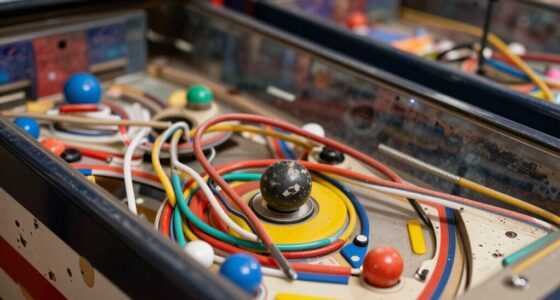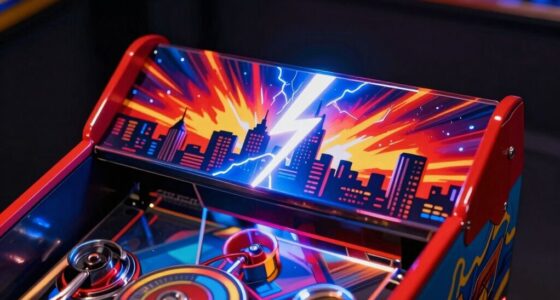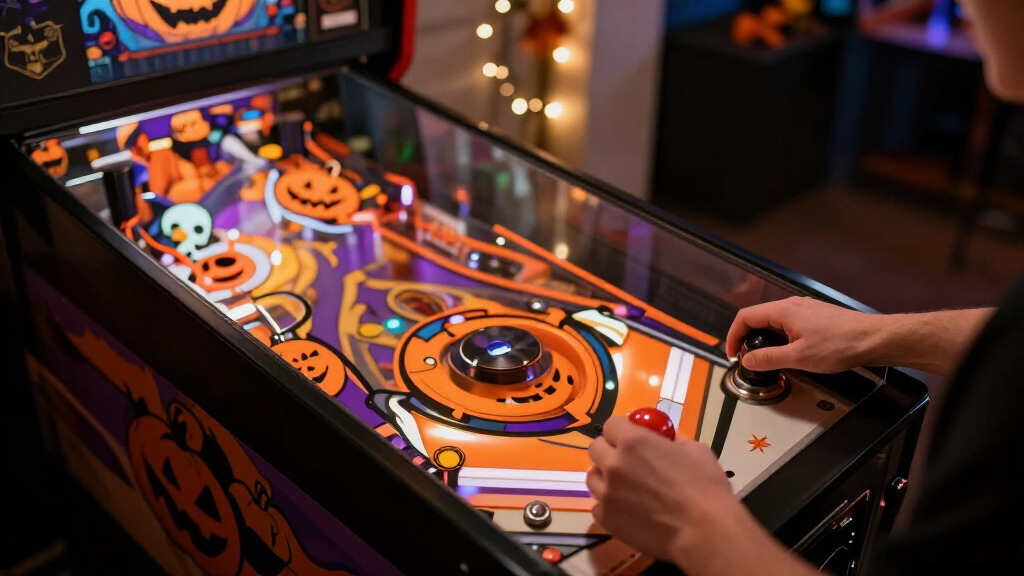

In 2022, pinball fans got an unusual situation: two officially licensed Halloween machines launched within months of each other, from two very different companies. Spooky Pinball, the boutique builder out of Benton, Wisconsin, released a limited-run Halloween machine co-designed with industry veteran Lyman Sheats Jr. handling rules. Stern Pinball, the largest manufacturer in the world, released its own Halloween machine built around a spinning Disc exit ramp and the franchi’s Michael Myers stalking the playfield. If you want a Halloween-themed pinball machine in your home, these are the two machines you will cross-shop, and they represent two distinct philosophies of what a modern pinball machine should be.

Play games on Amazon Luna for your game nights, included with Prime
- A rotating selection of games, no download needed
- Play on TV, laptop or phone
- Fast, free delivery for your gear, too
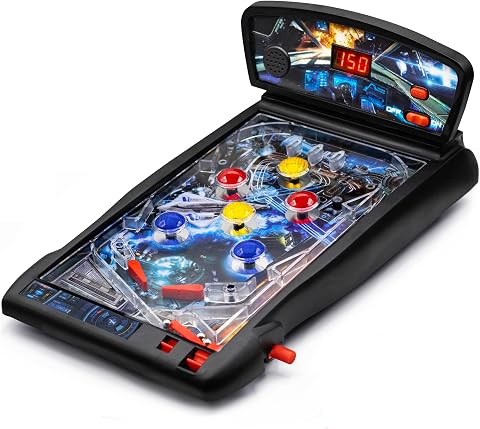
New Era Pinball Game, Black – Interactive Tabletop or Floor Arcade Pinball Machine
- ✔ Color: Black
- ✔ Dimensions: 21" L x 10" W x 4" H
- ✔ Balls: Up to 3 launched simultaneously
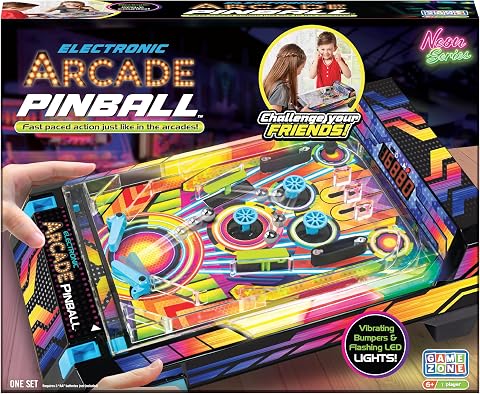
Kidoozie Electronic Arcade Pinball Tabletop Arcade Game
- ✔ Age Grade: 6 years and up
- ✔ Players: 1 player at a time
- ✔ Balls per Game: 3
The core tension is not theme — both are Halloween. It is everything else: production scale, code depth, art direction, mechanical risk, price, and what happens five years from now when something breaks. Spooky’s machine leans collector-heavy, with hand-built quality, layered rules, and a smaller community but real exclusivity. Stern’s machine leans mainstream, with Pro, Premium, and Limited Edition tiers, wider distribution, faster parts availability, and a bigger player base. This guide compares them side by side across the criteria that actually drive the purchase decision so you can decide which one belongs in your game room.
At a Glance
| Criteria | Spooky Pinball Halloween | Stern Pinball Halloween | Winner |
|---|---|---|---|
| Rules and code depth | Deep, layered rules by Lyman Sheats; long-ball oriented progression | Solid modern Stern rules; faster to learn, family-accessible modes | A |
| Playfield layout and shot variety | Unique Spooky layout, distinctive center shot design | Disc-based spinning ramp centerpiece; proven Stern shot geometry | Depends |
| Art and audio presentation | Hand-drawn art by Christopher Franchi; custom music and real film audio | Licensed film assets, screen animations, franchise-spanning audio | A |
| Build quality and components | Hand-built boutique assembly, high-quality standard parts | High-volume production, standardized Stern parts | Tie |
| Feature tiers and configuration options | One configuration, limited production run | Pro, Premium, and LE tiers with major feature differences | B |
| Price and availability | Higher street price due to limited supply; secondary market premium | Lower entry price on Pro; wide availability new and used | B |
| Long-term support and serviceability | Smaller company, slower parts pipeline, tighter community support | Best-in-class parts availability and technician network | B |
| Theme integration | Atmospheric horror tone, faithful to the 1978 film | Covers broader franchise with Michael Myers centrepiece toy | A |
New Era Pinball Game, Black – Interactive Tabletop or Floor Arcade Pinball Machine
When we picture a Halloween pinball machine, this is the machine we picture: dark black housing, six blinking LED lights, and eight arcade sound effects that turn a dim living room into a miniature haunted arcade. What separates the New Era Pinball Game from the Kidoozie is its signature multi-ball launch system — you can send one, two, or three balls flying simultaneously, which transforms pinball from a solitary reflex test into a riot of chaos that spectators genuinely enjoy watching. For a Halloween party, that chaos is the whole point.The LED scoring display gives it an arcade authenticity the Kidoozie’s simpler counter approaches but can’t quite match in presentation, and the flexible tabletop-or-floor design means you can set it on a snack table or lay it on the basement floor depending on your crowd. Compared with the Kidoozie’s fixed single-player format, the New Era’s faster pace keeps larger groups cycling through turns without long lulls. The tradeoffs are real, though: at roughly 21 inches long, it will disappoint anyone expecting full-size cabinet feel, and the eight sound effects — great on night one — can grow repetitive over a long evening. It’s also better suited to slightly older kids and adults than preschoolers, since three balls in play demands quicker reflexes.
Pros:
- Multi-ball launch (1-3 balls at once) creates fast, exciting party gameplay
- Six blinking LED lights and 8 sound effects deliver genuine arcade atmosphere
- LED scoring display makes competitive score-tracking easy
- Works on tabletop or floor and is compact enough to store between holidays
Cons:
- Small footprint won’t satisfy players wanting a full-size pinball experience
- Sound effects can become repetitive over extended play
- Faster multi-ball action may frustrate younger or slower-reflex players
Best for: Families, teens, and adults who want a flashy, fast-paced centerpiece for Halloween parties and game nights
Not ideal for: Players seeking authentic full-size pinball physics or very young children who need slower, simpler play
Bottom line: The New Era Pinball Game is the strongest Halloween pick overall because its multi-ball chaos, lights, and sound make it the machine guests will actually line up to play.
“The New Era Pinball Game is the strongest Halloween pick overall because its multi-ball chaos, lights, and sound make it the machine guests will actually line up to play.”
Kidoozie Electronic Arcade Pinball Tabletop Arcade Game
The Kidoozie Electronic Arcade Pinball plays a different game than the New Era, and that difference is its strength. Where the New Era overwhelms with three balls and rapid action, Kidoozie slows things down to a classic three-balls-per-game format that kids as young as six can actually follow. Its standout feature is the vibrating bumpers — a tactile kick you can feel through the table that the New Era doesn’t offer — and paired with flashing LEDs and an electronic score counter, it delivers a surprisingly convincing arcade feel for a compact unit.Compared with the New Era, this machine is the easier recommendation for a family Halloween with younger children: one ball in play means turns last longer, rules are instantly understood, and the score counter settles sibling disputes without argument. It’s also simpler to set up — attach the four feet, add batteries, and play — though note that the 3 AA batteries are not included, so buy them before Halloween night. The real limitations are structural: it’s single-player only, so it can’t host head-to-head simultaneous play, and there’s no multi-ball mode for guests craving faster thrills. For a Halloween party full of adults, the New Era wins; for a table of trick-or-treat-age kids rotating turns, this is the machine that fits.
Pros:
- Vibrating bumpers add tactile arcade realism kids can feel
- Electronic score counter handles scorekeeping automatically
- Simple 3-balls-per-game rules easy for ages 6+ to grasp instantly
- Quick assembly with included feet, ball, and instructions
Cons:
- Batteries (3 AA) not included
- Single-player format — no simultaneous head-to-head play
- Simpler pacing may bore older kids and adults used to faster machines
Best for: Families with kids ages 6 and up who want simple, turn-based arcade fun at a friendly price
Not ideal for: Adults or teens seeking fast multi-ball action, or groups wanting simultaneous two-player play
Bottom line: The Kidoozie Electronic Arcade Pinball is the smart pick for families with younger kids, trading the New Era’s multi-ball chaos for approachable, turn-based arcade fun.
“The Kidoozie Electronic Arcade Pinball is the smart pick for families with younger kids, trading the New Era’s multi-ball chaos for approachable, turn-based arcade fun.”
As an Amazon Associate we earn from qualifying purchases.
Key Differences
The single biggest practical difference is production philosophy. Spooky built Halloween as a limited-run boutique machine with one configuration, hand assembly, and rules designed by Lyman Sheats, whose code work on titles like AC/DC and Game of Thrones is regarded among the deepest in modern pinball. Stern built Halloween as a high-volume product in three tiers, where the Pro model drops the signature spinning Disc mechanism and several toys, meaning the machine you actually experience depends heavily on which tier you buy. This makes Stern more accessible on price but also more variable in what you get.
The second major difference is long-term ownership. A Stern machine can be serviced almost anywhere: parts flow through distributors, mods and replacement boards are abundant, and any pinball technician has worked on a thousand modern Sterns. A Spooky machine is supported by a smaller company with a slower parts pipeline and a much smaller installed base. That cuts both ways — Spooky owners report a close-knit community and direct factory relationships, but if you are not comfortable wrenching on your own machine or sourcing niche parts, Stern is the safer long-term bet.
Third is tone and depth. Spooky’s Halloween is built around atmosphere, custom Franchi art, and slow-burn strategic code that rewards hundreds of home plays. Stern’s Halloween is more immediate: flashier toys, screen-driven modes, and rules that a casual player or party guest can enjoy in five minutes. Neither approach is wrong — they serve different owners.
Detailed Comparison
Rules and code depth (Spooky Pinball Halloween wins — major)
Spooky’s biggest selling point is the rules package. Lyman Sheats Jr. is one of the most respected rules designers in pinball history, and the Spooky Halloween code leans toward layered progression, risk-reward choices, and long-form strategy that home players unpack over months. Stern’s Halloween code is competent and modern, with mode-based structure and franchise callouts, but it is generally regarded as faster to exhaust and less intricate than Sheats’ work. If your machine’s primary audience is you, playing repeatedly at home, the code gap is real. If your machine hosts parties and casual players, Stern’s accessibility is an advantage rather than a weakness — guests can trigger Michael Myers modes and understand what is happening within a few balls.
Playfield layout and shot variety (moderate difference)
Stern’s Premium and LE models feature the spinning Disc exit ramp — a rotating disc that catches the ball and physically spins it around the playfield toward shots — which is a genuine novelty and the machine’s signature moment. The Pro omits this and plays as a more conventional layout, which makes tier selection critical. Spooky’s layout is distinctive in a different way: an unconventional center shot structure and flow designed around its rules rather than around a headline toy. Players who value shot diversity and flow tend to rate the Spooky layout highly; players who value spectacle and physical gimmicks gravitate to Stern’s Premium. This one comes down to what kind of player you are, and the Pro/Premium split muddies a direct comparison.
Art and audio presentation (Spooky Pinball Halloween wins — moderate)
Spooky commissioned hand-drawn playfield and cabinet art from Christopher Franchi, widely praised as some of the best art in modern pinball, alongside custom music and audio from the original 1978 film’s aesthetic. The result feels like a loving, atmospheric tribute. Stern uses licensed film assets, screen animations on the LCD, and franchise audio — slick and polished, but more compilation-album than auteur. Collectors consistently cite Spooky’s art package as a reason the machine holds appeal; Stern’s presentation is professional and effective but less distinctive. For a theme machine, where visual identity matters enormously, this gap matters more than it would on a sports title.
Build quality and components (minor difference)
Both machines are well built, but differently. Spooky hand-assembles machines in small batches, and boutique QC standards plus careful assembly are part of what buyers pay for. Stern’s high-volume production is mature and consistent, with standardized components that are proven across thousands of machines. In practice both will hold up fine in a home environment; the difference is less about quality than about what happens when something fails — which favors Stern (see support below). For pure out-of-box fit and finish, Spooky’s small-batch care gives it a slight nod, though Stern machines are generally free of the QC drama that plagued earlier eras.
Feature tiers and configuration options (Stern Pinball Halloween wins — moderate)
Stern offers Pro, Premium, and Limited Edition versions. The Pro is the affordable entry but loses the Disc mechanism and key toys; the Premium is the full experience; the LE adds cosmetics and collectibility at a steep premium. Spooky offers essentially one configuration — what you see is what everyone gets. This cuts both ways: Stern’s tiers let you match budget to features, but they also mean the ‘Stern Halloween experience’ varies wildly depending on which version sits in front of you, and LE buyers pay a large premium for paint and numbering. Spooky’s single config is simpler and more equitable among owners. Stern wins on flexibility, but buyers must shop carefully.
Price and availability (Stern Pinball Halloween wins — major)
On the used market, Spooky Halloween commands a premium because production was limited — expect to pay well above original MSRP for a clean example, and supply is thin. Stern’s Pro is the cheapest way into the theme by a wide margin, Premiums trade closer to original pricing, and supply is far healthier. If budget is a constraint, Stern Pro is the only realistic option of the two; if you want the Spooky, you are paying collector pricing and you should treat part of that spend as an asset play rather than pure entertainment spend. For most buyers with a fixed budget, Stern wins this outright.
Long-term support and serviceability (Stern Pinball Halloween wins — major)
This is where the production-scale difference bites. Stern’s parts ecosystem is the best in pinball: boards, mechs, plastics, and mods are available from multiple distributors, and virtually every technician knows modern Stern architecture. Spooky is a smaller operation with a real but slower parts pipeline and a much smaller installed base, meaning some fixes may require direct factory contact and patience. Home owners who do their own maintenance report good experiences with Spooky support, but if you plan to rely on local service or want maximum mod availability, Stern is clearly the safer long-term ownership proposition.
Theme integration (Spooky Pinball Halloween wins — moderate)
Spooky’s machine is built around the 1978 original: the atmosphere, the Carpenter tension, the Franchi art — it feels like a single cohesive artistic statement about one film. Stern’s machine spans the franchise more broadly, with Michael Myers as the centerpiece toy and assets drawn across the films. Which is better depends on your relationship with the property: devotees of the original film tend to prefer Spooky’s focused treatment; fans of the franchise as a whole, or buyers who just want the most recognizable slasher icon in pinball form, are well served by Stern. As a piece of thematic execution, Spooky’s single-vision approach is stronger.
Spooky Pinball Halloween: Pros and Cons
Pros:
- Rules by Lyman Sheats — some of the deepest code in modern pinball
- Hand-drawn Christopher Franchi art, among the best in the hobby
- Limited production run supports collector value and exclusivity
- Faithful, atmospheric tribute to the 1978 film with custom audio
- Single configuration — no tier confusion or feature envy
Cons:
- High and rising secondary-market pricing
- Limited supply makes examples hard to find
- Smaller parts ecosystem and slower support pipeline
- Code and layout favor dedicated players over casual guests
- Small installed base means fewer mods and community resources
Stern Pinball Halloween: Pros and Cons
Pros:
- Three price tiers let buyers match budget to features
- Best parts availability and technician familiarity in pinball
- Spinning Disc ramp on Premium/LE is a genuine spectacle
- Accessible rules work well for families and parties
- Healthier new and used supply at lower price points
Cons:
- Pro tier omits the signature Disc mechanism and key toys
- Code is solid but shallower than Spooky’s Sheats rules
- Art and presentation are polished but less distinctive
- LE pricing is hard to justify on features alone
- Franchise-spanning assets feel less cohesive than a single-film vision
Who Should Choose What
Choose Spooky Pinball Halloween if:
- You are a dedicated home player who will put hundreds of balls on the machine and wants code that keeps revealing itself
- You collect modern pinball and care about limited runs, art packages, and long-term collectibility
- You love the 1978 film specifically and want the machine that treats it as art rather than a license
- You are comfortable doing your own basic maintenance and value factory relationships over local service networks
Choose Stern Pinball Halloween if:
- You want the cheapest credible path into a Halloween-themed machine — the Pro is far more affordable than any Spooky
- Your machine will get mixed casual use: parties, kids, guests who need to enjoy it in five minutes
- You want maximum serviceability, parts availability, and mod support for years of ownership
- You want the full toy experience (Disc ramp) and can stretch to the Premium
Skip both if: If you mainly want a modern, deep-playing pinball machine and the Halloween theme is a nice-to-have rather than a requirement, titles like Godzilla or other top-tier modern machines offer better overall gameplay per dollar — buy the theme only if it genuinely matters to you.
Value for Money
Value depends on what you are buying. Stern’s Pro is the clear value winner as pure entertainment: it is the cheapest way to own the theme, it is deeply supported, and depreciation on used examples tends to be modest. The Premium is the tier most worth paying up for, because the Disc ramp is the machine’s identity — a Pro is a decent Stern with Halloween art, while a Premium is the actual Halloween machine Stern designed. The LE is difficult to justify on features; you are paying a large premium for cosmetics and a plaque, and value there is a bet on collectibility rather than utility.
The Spooky is a different value proposition. You pay a collector premium, supply is thin, and the money buys depth and art rather than toys and support. For a player who will genuinely use the machine heavily, that premium converts into years of engagement with code that does not run dry — arguably better cost-per-hour value than a flashier machine you tire of. For an owner who plays occasionally or plans to resell quickly, the premium is harder to recover unless the collector market stays strong, which limited Spooky runs have historically done, though with no guarantee.
Final Verdict
For most buyers, Stern Halloween is the right call — specifically the Premium. It is more affordable, easier to buy, easier to service, better suited to mixed household use, and the Disc ramp version delivers the experience people actually picture when they imagine a Halloween pinball machine. If your budget caps you at Pro money, the Stern Pro still makes sense, but go in knowing you are skipping the machine’s signature feature. Choose Spooky Halloween if you are a serious home player or collector for whom the Sheats rules, Franchi art, and limited-run character justify the premium — it is the better machine to own deeply, just not the better machine to buy casually.
The single deciding factor is how you will use the machine. One primary owner playing constantly and valuing depth: Spooky. Shared use, parties, and practical ownership: Stern Premium. Everything else — art, tier structure, support — flows downstream from that one question.
Frequently Asked Questions
The Premium is worth the upcharge for most buyers because the spinning Disc exit ramp is the machine’s defining feature, and the Pro omits it along with key toys. Buy the Pro only if budget is firm and you mainly want affordable Halloween theming with solid Stern gameplay — just understand it plays like a different, more conventional machine.
Which machine has deeper rules for long-term home play?
The Spooky Halloween, clearly. Lyman Sheats’ rules are layered and built for hundreds of home plays, while Stern’s code is polished but faster to fully explore. If code depth is your top priority, this difference alone can decide the purchase.
Which machine is easier to maintain and get parts for?
Stern, by a wide margin. Its parts ecosystem, distributor network, and technician familiarity are the best in pinball. Spooky support is genuine but slower, with a smaller installed base, so Spooky ownership suits owners comfortable with some self-service and patience.
Which one holds value better as a collectible?
Limited-run Spooky machines have historically held or gained value due to scarcity and strong art packages, and Halloween’s theme gives it durable demand. Stern LEs also hold value reasonably, but Stern’s larger production numbers cap appreciation. Treat any collectible premium as a bet, not a guarantee.
Which is better for a family game room with kids and guests?
Stern Halloween. Its rules are accessible in minutes, the toys and modes deliver instant spectacle for casual players, and the Pro/Premium range lets you match the machine to your budget and space. Spooky’s slower, deeper code is wasted on a machine dominated by casual play.
Fall Picks
fall essentials
As an affiliate, we earn on qualifying purchases.