
TL;DR

Play games on Amazon Luna for your game nights, included with Prime
- A rotating selection of games, no download needed
- Play on TV, laptop or phone
- Fast, free delivery for your gear, too
A comparison of 10 webcams found that AI tracking, gesture control and automated framing are becoming practical features for presenters and streamers. The report also found that sensor quality, software support and frame rate often matter more than 4K resolution, especially during compressed video calls.
A comparison of 10 popular 4K webcams has found that AI subject tracking, automated framing and gesture control are becoming useful tools for presenters and live streamers, but they do not yet make AI cameras the clear choice for every video call. The Thorsten Meyer AI report named the Logitech MX Brio its best overall model and the EMEET PIXY its leading option for automated movement and tracking.
The report compared products from five brands across office calls, teaching, fitness instruction, product demonstrations and streaming. Its central finding was that sensor size and image processing affect real-world quality more than a 4K label alone. The MX Brio ranked first because its larger pixels and low-light tuning produced the strongest image in the comparison, according to the publisher.
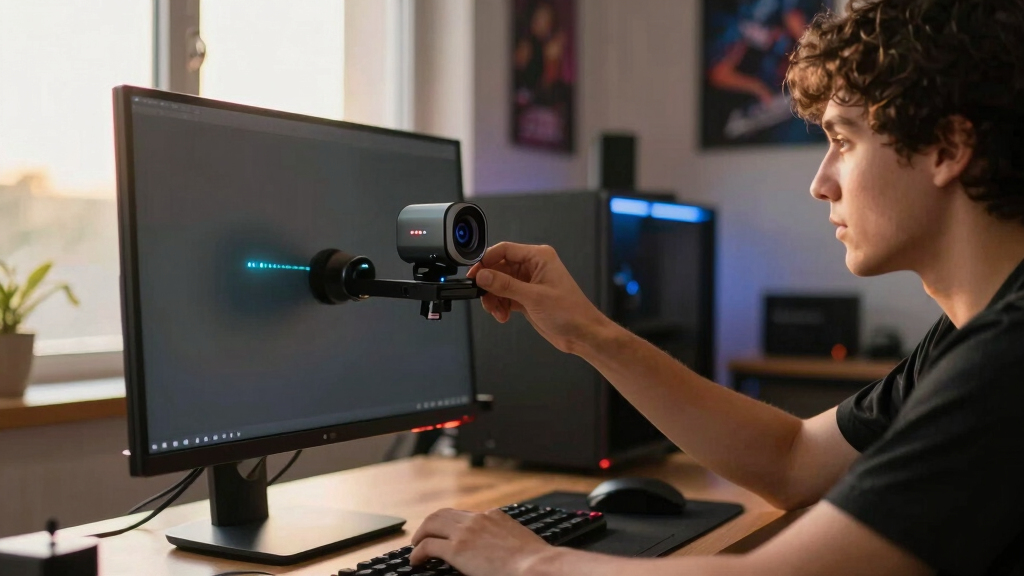
For users who move while presenting, the report selected the EMEET PIXY, which combines a dual-camera design with AI tracking, gesture control, 310-degree pan and 180-degree tilt. Those functions depend on EMEET Studio setup, and their performance was reported by Thorsten Meyer AI rather than independently verified for this article.
The comparison also found that most models record 4K video at 30 frames per second while offering 1080p at 60fps. The faster lower-resolution mode may produce smoother results for rapid movement. The EMEET C60E adds dual lenses and up to 11X hybrid zoom, but the report says zoom cannot be combined with 4K, 60fps or YUY2 modes.
AI Features Serve Specific Users
The findings suggest AI webcams are most valuable when they solve a defined production problem. Teachers, coaches and standing presenters can remain centered without a camera operator, while streamers and product demonstrators can use tracking, close-ups and automated framing to reduce manual adjustments.
The case is weaker for workers who remain seated during routine calls. Zoom and Microsoft Teams compress video below the camera’s maximum capture quality in many situations, according to the report. For those buyers, reliable autofocus, microphone quality and low-light performance may have more visible impact than 4K resolution or motorized tracking.
Price is also changing the market. The comparison says sub-$100 4K cameras, including the EMEET C960 and lower-cost alternatives, now meet the basic resolution target. Yet cheaper models may compromise on microphones, mount stability and software support, making headline specifications an incomplete guide to performance.
As an affiliate, we earn on qualifying purchases.
Webcams Move Beyond Fixed Framing
Webcams have traditionally depended on fixed framing and digital cropping. Higher-resolution sensors created more room to crop or zoom, while newer models added automated subject detection, motorized pan-and-tilt hardware and gesture-based controls. These additions move some production tasks from software or camera operators into the device itself.
The market now spans several distinct uses. The report places the EMEET PIXY in tracking, the EMEET C60E in close-up framing, the EMEET S600 in streaming value and the EMEET C960 and NOVA in lower-priced 4K capture. Logitech’s older Brio 4K remains relevant for Windows Hello facial recognition and adjustable fields of view on supported Windows systems.
“The Logitech MX Brio earns the top spot because of its larger sensor and low-light tuning, not its resolution.”
— Thorsten Meyer AI comparison
Tracking Reliability Lacks Broad Testing
It is not yet clear how consistently the cited AI tracking and gesture controls work across different rooms, lighting conditions, skin tones, group sizes and operating systems. The source provides comparative conclusions and product specifications, but it does not disclose a standardized test protocol, long-term reliability results or independent verification.
Software support is another open issue. Some functions require manufacturer companion applications, and future operating-system updates could affect compatibility. Prices and firmware may also change, while features such as the C60E’s zoom remain unavailable in several high-resolution or high-frame-rate modes.
Software Support Will Decide Adoption
Manufacturers’ next step will be to show that tracking remains dependable beyond controlled demonstrations and that companion software receives sustained updates. Buyers should watch for firmware changes, broader application compatibility and cameras that combine 4K capture, high frame rates and optical movement without disabling other advertised functions.
For now, the report supports a role-based buying decision: choose AI PTZ tracking for movement-heavy presentations, prioritize 60fps modes for fast action, and favor sensor quality and software stability for everyday calls. Wider adoption will depend less on the AI label than on whether these features work reliably in daily use.
Key Questions
What makes a webcam an AI webcam?
An AI webcam uses automated detection to identify and follow a subject, adjust framing or respond to gestures. Some models pair these functions with motorized pan-and-tilt hardware, while others crop the image digitally.
Which AI webcam led the comparison?
The report selected the EMEET PIXY for streaming and tracking because it offers AI subject following, gesture control and 310-degree pan with 180-degree tilt. Full functionality requires EMEET Studio software.
Was the best overall webcam an AI tracking model?
No. The Logitech MX Brio was the report’s best overall choice because of its larger sensor, low-light results and mature companion software, rather than motorized tracking.
Is 4K useful for ordinary Zoom or Teams calls?
Its benefit may be limited because video-call platforms compress footage. The extra resolution is more useful for local recording, digital cropping and close-up framing than for many routine meetings.
Are AI webcams the future of live streaming?
They are becoming a practical option for solo creators and moving presenters, but the evidence does not establish that they will replace standard webcams. Adoption depends on tracking accuracy, software support, price and mode restrictions.
Source: Thorsten Meyer AI
Evergreen bestsellers Picks
bestsellers
As an affiliate, we earn on qualifying purchases.