In classic racing games, smart visual and sound tricks made you feel like you were going faster than the game’s actual speed. Bright colors, bold outlines, and motion blur created a sense of rapid movement, while sound effects grew more intense with acceleration. Quick background scrolling and focus on the racing line enhanced the illusion of speed. These perceptual cues tap into how your senses process motion, making you feel lightning-fast, even if the actual speed was moderate. Keep exploring to discover how they pull this off.
Key Takeaways
- Bright colors, bold outlines, and exaggerated motion lines create an intense visual sense of speed.
- Rapid background scrolling and motion blur effects simulate high velocity effectively.
- Audio cues like roaring engines and wind sounds escalate with acceleration, reinforcing perceived speed.
- Visual focus on racing lines and tunnel-like perspectives limit peripheral vision, enhancing speed sensation.
- Minimalistic yet impactful visual and auditory feedback leverage subconscious perceptual cues to amplify speed perception.
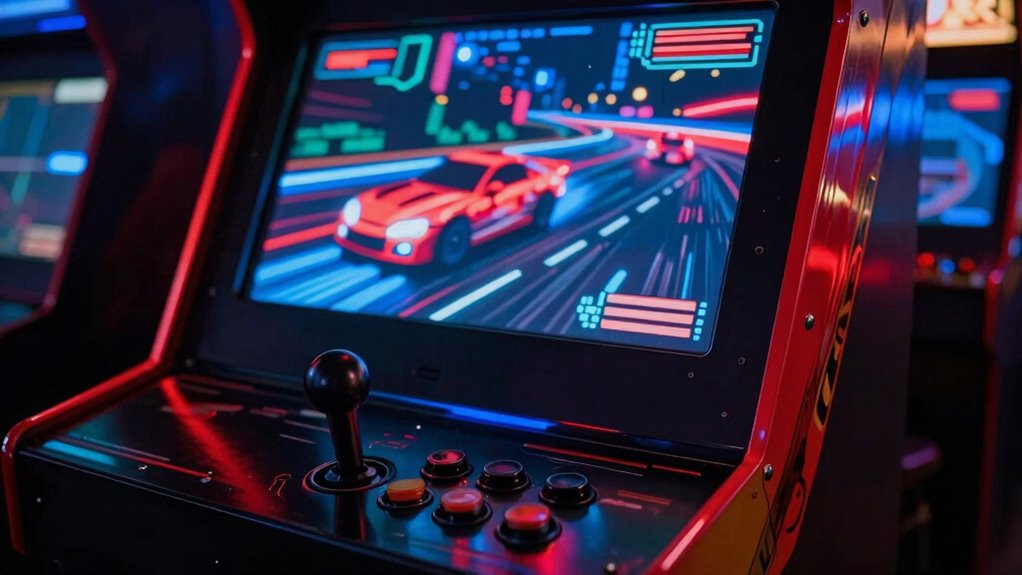
Many players remember classic racing games as feeling much faster than they actually were, and this perception isn’t just nostalgia—there are real design reasons behind it. Developers intentionally crafted these games to maximize excitement and adrenaline, often by leveraging visual and auditory cues that trick your brain into perceiving higher speeds. One of the key elements contributing to this illusion is the use of arcade graphics. These graphics, characterized by bright colors, bold outlines, and exaggerated motion lines, create a sense of rapid movement even when the actual in-game speed is moderate. The visuals are designed to be simple yet dynamic, so your eyes are constantly drawn to the motion, making it feel like you’re hurtling along at breakneck speeds.
Arcade graphics with bold outlines and motion lines create the illusion of high speed even at moderate velocities.
Sound design also plays a vital role in amplifying this sensation. Classic racing games often feature roaring engines, whirling wind noises, and other fast-paced sound effects that escalate in intensity as you accelerate. These sounds are carefully calibrated to match the perceived velocity, creating an immersive experience where your brain interprets the auditory cues as signs of high speed. When combined with arcade-style graphics, the sound design reinforces the feeling that you’re moving faster than the game’s engine actually allows.
Another factor is the way these games handle visual feedback during gameplay. For example, many classics include motion blur effects or rapid scrolling backgrounds that give the illusion of swift movement through the environment. These visual tricks are minimalistic but highly effective, allowing you to focus on the racing line while still feeling the rush of speed. Additionally, the use of perspective—such as a narrow, tunnel-like view—limits your field of vision, making acceleration feel more intense because your peripheral vision isn’t available to judge the surroundings, only the forward motion. Furthermore, these design choices exploit perceptual cues, which are subconscious signals that influence how we interpret visual information and perceive speed. Creating a sense of perceived velocity often involves manipulating these cues to enhance the sensation of rapid movement. Interestingly, these cues tap into our innate visual perception processes, which are finely tuned to detect motion and speed in our environment. Researchers have also found that contextual cues can significantly influence how we perceive motion, further amplifying the sensation of speed in these games.
The combination of arcade graphics, sound design, and clever visual effects creates a sensory environment that amplifies your perception of speed. Developers knew that players crave excitement, so they crafted experiences where the sensation of velocity outstripped the actual numbers on the screen. As a result, you felt like you were racing at lightning-fast speeds, even when the game’s mechanics kept things at a more manageable pace. This masterful use of audiovisual cues is a big reason why classic racing games continue to evoke that exhilarating feeling of high velocity, long after the pixels have faded.

PlayStation Move Motion Controllers – Two Pack
- Enhanced motion sensing technology: Advanced motion sensing and light tracking
- Accessible controls: Easily accessible trigger and face buttons
- Realistic feedback: Immersive vibration feedback
As an affiliate, we earn on qualifying purchases.
As an affiliate, we earn on qualifying purchases.
Frequently Asked Questions
How Did Graphics Influence Perceived Speed in Classic Racing Games?
Graphics illusions and visual cues played a big role in how fast you perceived classic racing games to be. Developers used motion blur, rapid scrolling backgrounds, and dynamic track details to create a sense of speed. These visual tricks trick your brain into feeling the car was moving faster than it really was, making the gameplay more exciting. Your eyes pick up these cues, amplifying the sensation of speed on the screen.
Were Sound Effects Designed to Enhance the Sensation of Speed?
Yes, sound effects were designed to enhance the sensation of speed. While visual cues like motion blur and rapid scenery changed helped your brain perceive faster movement, synchronized engine roars and wind noises intensified that feeling. This juxtaposition of visuals and sound created a more immersive experience, tricking you into feeling like you were racing at breakneck speeds, even if the actual game speed was more modest.
Did Game Design Intentionally Create a Faster-Than-Real Feeling?
Yes, game designers intentionally created a faster-than-real feeling using visual illusions like exaggerated motion blur and perspective tricks. These elements make you perceive increased speed, even if the actual game physics are realistic. By emphasizing visual cues, designers trick your brain into experiencing a more thrilling, high-velocity sensation, enhancing excitement without needing to increase actual game speed. This clever use of visual illusion keeps gameplay engaging and immersive.
How Did Hardware Limitations Impact the Sensation of Speed?
Imagine driving a real car with limited visibility—hardware constraints in classic racing games shaped your sensory perception of speed. Because of hardware limitations, developers used quick frame updates and minimal detail to enhance the sensation of rapid movement. These constraints forced designers to exaggerate motion cues, making you feel faster than reality. As a result, hardware restrictions unintentionally boosted your sense of speed, creating a thrilling, immersive experience.
Were Player Expectations Shaped by Arcade-Style Gameplay?
Yes, player expectations were shaped by arcade-style gameplay, influencing how you perceived speed. Arcade games emphasized fast-paced, thrilling experiences, which heightened your player psychology and made you feel like you were moving faster. Nostalgia effects also played a role, as you associate these games with adrenaline and excitement, further amplifying the sensation of speed. This combination kept you engaged and convinced you that the gameplay was more intense than reality.
Conclusion
So, next time you jump into a classic racing game, remember it wasn’t just your imagination — those games truly felt faster than lightning. It’s like they had the power to bend reality, making every turn and burst of speed feel like you were racing through a storm of adrenaline. Despite their actual speed, they somehow made you believe you were flying past the limits of physics itself. That’s the magic of vintage racing games, forever etched in digital history.