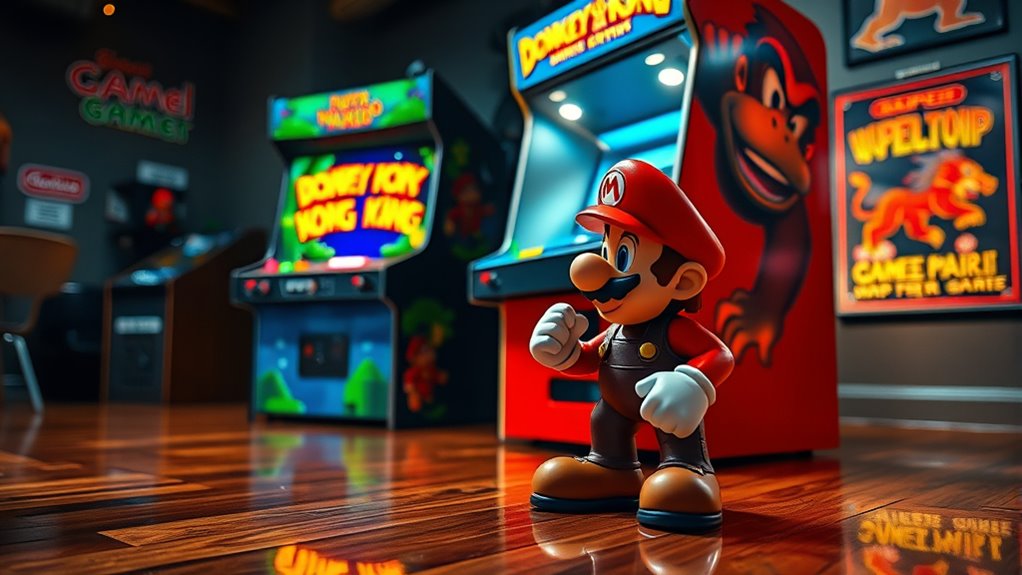

When you look at Donkey Kong’s release in 1981, you’ll see it’s more than just an arcade game—it’s the birth of Mario, originally called Jumpman. Nintendo’s innovative design introduced a colorful, simple character with a memorable silhouette, setting the stage for future iconic heroes. This game revolutionized gameplay and character design, leaving a lasting legacy. If you keep exploring, you’ll uncover how Donkey Kong shaped the future of video games and storytelling.
Key Takeaways
- Donkey Kong introduced Jumpman, who later became Mario, marking the birth of Nintendo’s iconic mascot.
- The game’s character design emphasized simplicity and silhouette clarity, influencing future character development.
- Donkey Kong’s success established Nintendo’s reputation and paved the way for the Mario franchise.
- Jumpman’s transformation into Mario reflected evolving game design focusing on memorable, recognizable characters.
- The game’s visual style and gameplay focus set standards for future platformers and character design in gaming history.
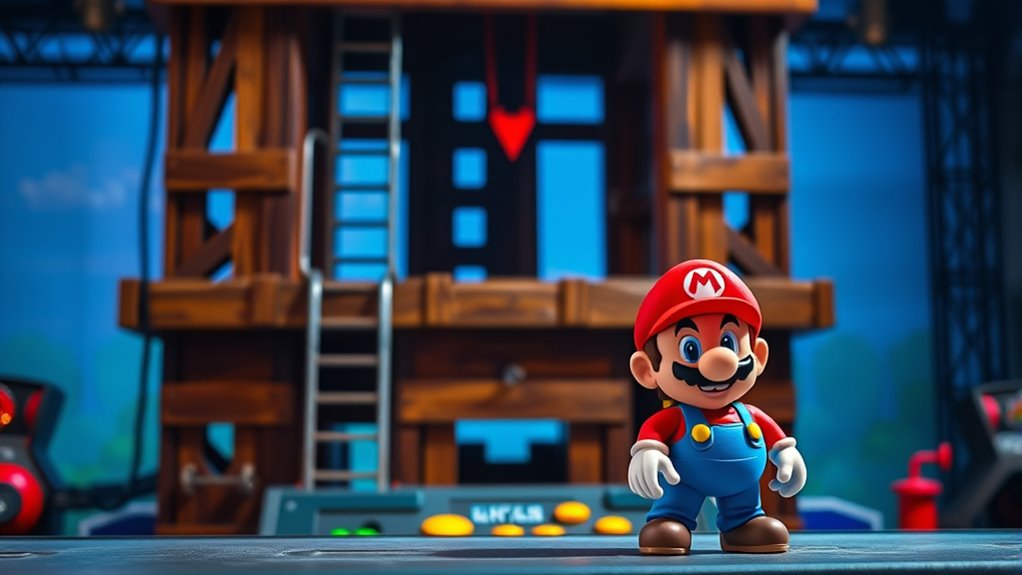
Before Donkey Kong became a household name, it played a pivotal role in shaping the future of video games by introducing a character who would later become one of the most iconic figures in gaming history. This arcade game, developed by Nintendo in 1981, was revolutionary not just for its gameplay but also for its character design. You might not realize it, but the game’s visual style and character choices set the foundation for how video game heroes would be crafted in the years to come. The game’s protagonist, Jumpman—later known as Mario—was a simple sprite, but his design was carefully thought out to be memorable and easily recognizable on the arcade screen. His red hat, blue overalls, and mustache created a distinct silhouette that players could instantly identify, a vital factor in arcade game success where quick recognition mattered.
You find yourself immersed in the game’s design, controlling this plucky carpenter as he navigates platforms and avoids obstacles to rescue his girlfriend from Donkey Kong. The character design’s simplicity was a strategic move; it allowed players to focus on gameplay without distraction, yet still conveyed personality and charm. You might notice the contrast between Jumpman’s bright colors and the dark, menacing backdrop of the game. This visual clarity helped the game stand out in crowded arcades and guaranteed players could pick up and understand the game’s premise in seconds. The character design also played a role in the game’s appeal across different audiences, from casual players to dedicated arcade enthusiasts.
As you continue to play, you see how the character’s design influences the game’s overall aesthetic, establishing a visual language that Nintendo would refine with future characters. The simplicity of Jumpman’s appearance made him adaptable for later iterations and inspired a lineage of characters who prioritized clear, iconic silhouettes over complex detail. This approach revolutionized arcade game character design, emphasizing that memorable characters don’t need to be overly detailed but should be visually striking and instantly recognizable. Additionally, character design is a key element in creating lasting brand recognition and emotional connection with players.
In essence, Donkey Kong’s success was not just about gameplay but also about its character design—an element that helped define what a compelling arcade game character should be. Jumpman’s transformation into Mario, built on this foundation, would go on to influence countless games, proving that a well-crafted character design can elevate an entire genre and leave a lasting legacy in the world of gaming.

My Arcade Ms. Pac-Man Joystick Player: Retro Arcade Classics, 3.5" Screen
- Officially Licensed Title: Authentic Bandai Namco game experience
- Two Game Modes: Classic and speed-up modes included
- Celebrates Female Gamers: Honors women in gaming history
As an affiliate, we earn on qualifying purchases.
As an affiliate, we earn on qualifying purchases.
Frequently Asked Questions
Who Was the Original Designer Behind Donkey Kong?
You should know that Shigeru Miyamoto was the original designer behind Donkey Kong. He crafted the arcade gameplay that captivated players, despite the hardware limitations of the time. Miyamoto’s innovative approach turned a challenging concept into a hit, laying the groundwork for future Nintendo classics. His creativity and understanding of arcade hardware limitations helped shape the game’s success and set the stage for Mario’s legendary debut.
How Did Donkey Kong Influence Future Nintendo Characters?
Donkey Kong’s arcade legacy greatly influenced future Nintendo characters by setting a standard for iconic character design. You see, its simple yet expressive visuals inspired Nintendo to craft memorable characters like Mario, who became central to their game universe. This game’s innovative character design and gameplay mechanics shaped how characters are developed, ensuring that future Nintendo heroes retain a timeless appeal that resonates with players across generations.
What Was the Initial Public Reaction to Donkey Kong’s Release?
You might have noticed that Donkey Kong’s debut was met with a wave of curiosity and excitement. Its pop culture impact quickly grew as players flocked to arcades, boosting its popularity. While some critics were cautious at first, most embraced the game’s innovative gameplay. Overall, the initial public reaction was overwhelmingly positive, establishing Donkey Kong as a beloved classic and setting the stage for Nintendo’s future success in gaming.
Were There Any Alternate Versions of Donkey Kong During Development?
During development, you discover that there were several arcade prototypes and unused concepts for Donkey Kong. These alternate versions explored different gameplay mechanics and graphics, but were ultimately abandoned. You might find that some prototype footage or screenshots reveal early ideas that never made it to production. These prototypes give insight into the game’s evolution, showing how designers refined their vision before the final release.
How Did Mario’s Character Evolve After His Debut?
Think of Mario’s character development as a garden growing over time. After his debut, he evolved from a carpenter to a plumber, reflecting Nintendo’s desire for a relatable hero. The evolution of Mario included adding personality, voice, and diverse skills, making him more engaging. His character became iconic, embodying resilience and humor, which helped him become Nintendo’s mascot. This growth kept players connected and enthusiastic to see what he’d do next.
Conclusion
So, as you piece it together, the theory that Donkey Kong’s creation sparked Mario’s rise feels pretty spot-on. Nintendo’s developers cleverly transformed a simple arcade game into a legendary hero’s debut, turning a giant ape into a lovable plumber. You can see how this evolution shaped gaming history, blending creativity and strategy. It’s almost like the game itself was destined to create Mario—proof that even the wildest ideas can become iconic.