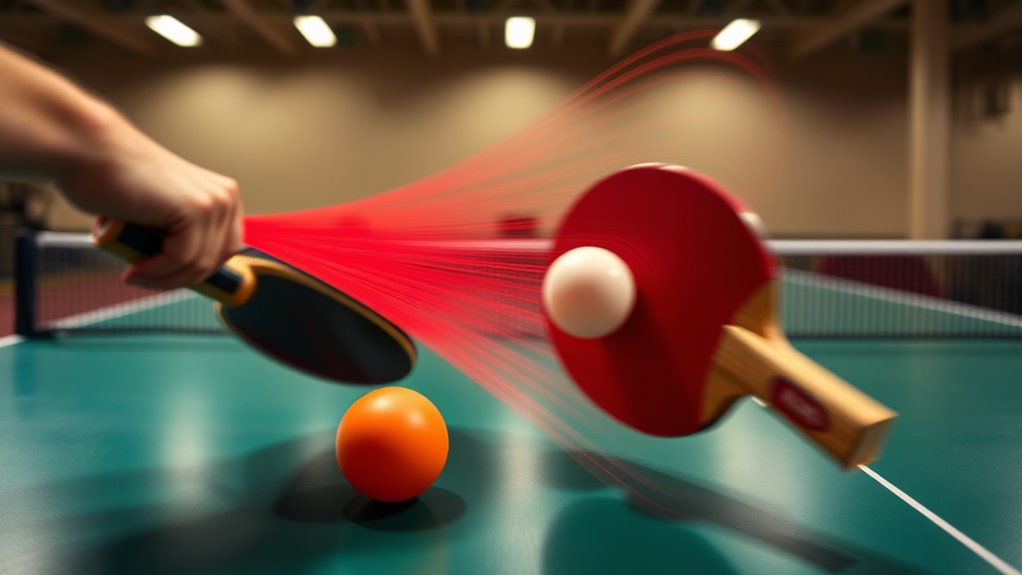

To master advanced ping pong spin techniques and counter‑spins, focus on controlling your racket angle and brushing the ball to neutralize heavy topspin and sidespin. Practice reading spin cues during flight to adjust your strokes quickly and accurately. Incorporate deliberate racket adjustments like opening or closing your racket face to counter various spins effectively. Continuing to refine these skills will help you dominate rallies and turn defensive plays into offensive opportunities.
Key Takeaways
- Master brushing techniques with a slightly closed racket face to generate and control advanced spin variations.
- Learn to read and anticipate opponent’s spin cues early for effective counter-spins and adjustments.
- Adjust racket angle dynamically to neutralize sidespin and heavy topspin during fast exchanges.
- Incorporate quick, controlled racket movements to respond to complex spin patterns with precision.
- Practice combining defensive spin control with offensive spin variation to keep opponents off-balance.
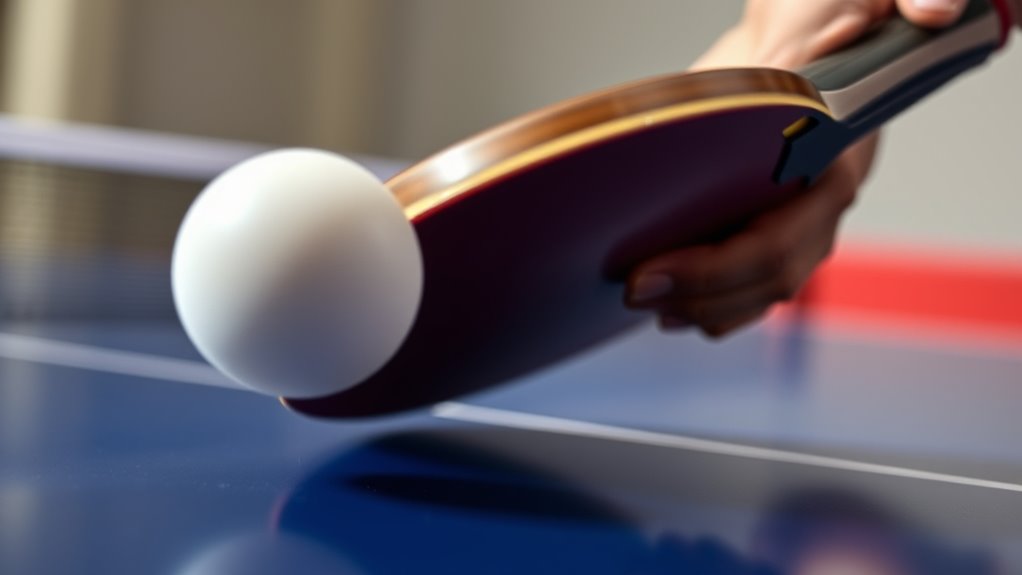
Mastering advanced ping pong spin techniques can give you a essential edge over your opponents, especially when you learn how to generate and counter various spins effectively. One of the most fundamental skills is developing a strong topspin defense. When your opponent applies heavy topspin, it can seem intimidating to return their shot without losing control or sending the ball long. To counter this, you need to focus on controlling your racket angle and adjusting your stroke to absorb the spin. Instead of trying to hit through the ball, let the spin do some of the work by brushing the ball with a slightly closed racket face. This technique allows you to neutralize the topspin and return the ball with a controlled, low trajectory, setting yourself up for the next offensive shot. Practicing this consistently will improve your ability to handle aggressive topspin shots and keep rallies alive. Recognizing the different types of spin and how they affect ball trajectory is crucial for developing these skills.
Sidespin variations add another layer of complexity to your game. When you encounter opponents using sidespin, your goal shifts to reading the direction and magnitude of the spin before responding. Sidespin can make the ball curve unexpectedly, making it harder to predict where it will land. To counter sidespin, you need to adjust your racket angle accordingly—opening or closing it based on the ball’s spin direction. For instance, if you’re facing a ball with sidespin that curves to your forehand, you might need to open your racket slightly to counteract the spin and keep the ball on the table. Mastering sidespin variations demands keen observation and quick reflexes, as well as deliberate practice in reading the spin during the ball’s flight. The more you familiarize yourself with different spins, the better you’ll become at adjusting your strokes on the fly, turning your opponent’s spin against them.
It’s also essential to incorporate these defensive techniques into your overall strategy. When you can effectively counter topspin and sidespin variations, you not only neutralize your opponent’s attack but also create opportunities to switch to offensive play. For example, after successfully returning a heavy topspin, you might capitalize with a quick loop or smash if your timing is right. Similarly, intercepting sidespin shots with precise racket adjustments can give you the advantage of placing difficult returns or forcing errors. Developing this level of control requires consistent practice, focusing on your racket positioning, timing, and reading your opponent’s spin cues. Over time, this mastery transforms your defensive game into a powerful weapon, enabling you to stay in rallies longer and seize offensive opportunities when they arise. Improving your ability to read and react to spin is fundamental to elevating your overall ping pong performance.

PRO-SPIN Ping Pong Paddles – ITTF Approved Professional Table Tennis Rackets with Carbon Fiber for Superior Control | 7-Ply Blade, Premium Rubber, 2.0mm Sponge (Red, 1-Pack)
- ITTF Approved Rubber: Certified for competition play
- Carbon Control & Precision: Enhanced spin and stability
- 7-Ply Blade Construction: Premium wood and carbon layers
As an affiliate, we earn on qualifying purchases.
As an affiliate, we earn on qualifying purchases.
Frequently Asked Questions
How Do I Diagnose Which Spin Type My Opponent Is Applying?
To diagnose which spin your opponent is applying, focus on spin detection during the rally. Watch their paddle contact and ball trajectory closely, noting any sideways or downward movement. Pay attention to how the ball reacts after bouncing—whether it spins back or skews off. Use opponent analysis by observing their grip, stroke, and racket angle, which helps you identify their spin type and prepare effective counter-spins.
What Equipment Best Enhances Spin Control and Variation?
You should choose a rubber with good grip and tackiness, like high-quality spin-enhancing rubbers, to improve your spin control and variation. Opt for a paddle with a balanced weight—around 160-180 grams—so you can maneuver easily without sacrificing power. This combination allows you to generate more spin, adjust your shots effectively, and keep your opponent guessing. Experiment with different rubbers and paddle weights to find what best suits your playing style.
How Can I Train Effectively to Improve My Spin Consistency?
Did you know that consistent practice can improve your spin accuracy by up to 30%? To train effectively, focus on drill repetition, practicing your spins regularly to build muscle memory. Stay mentally focused during each session, avoiding distractions to reinforce proper technique. Break your training into manageable sets, review your progress, and gradually increase difficulty. This disciplined approach will boost your spin consistency and overall game performance.
Are There Specific Grips That Maximize Spin Generation?
You’ll want to experiment with your paddle grip, such as the shakehand or penhold grip, to find which maximizes spin. Adjust your racket angle during strokes—tilting it slightly can generate more spin. Keep your grip firm yet flexible, allowing for quick wrist movements. Consistently practicing these adjustments helps develop better control and increases your spin potential during matches.
How Do Environmental Factors Affect Spin and Counter-Spin Effectiveness?
Environmental factors like humidity impact spin and counter-spin effectiveness by affecting the ball and paddle grip. High humidity can make the ball less responsive and cause your paddle to slip, reducing spin control. The table surface also plays a role; a smooth, dry surface enhances spin transfer, while a damp or uneven surface diminishes it. Adjust your technique based on these conditions to maintain peak spin and counter-spin performance.
Conclusion
Mastering advanced spin techniques is like learning to ride a wave—you need to understand the currents and adjust your stance. When I first tried counter-spins, I felt like a surfer catching unpredictable swells. With practice, you’ll develop the instinct to read your opponent’s moves and respond with precision. Just as surfers ride the crest, you’ll harness spin to dominate the table, turning every rally into a thrilling display of skill and control.