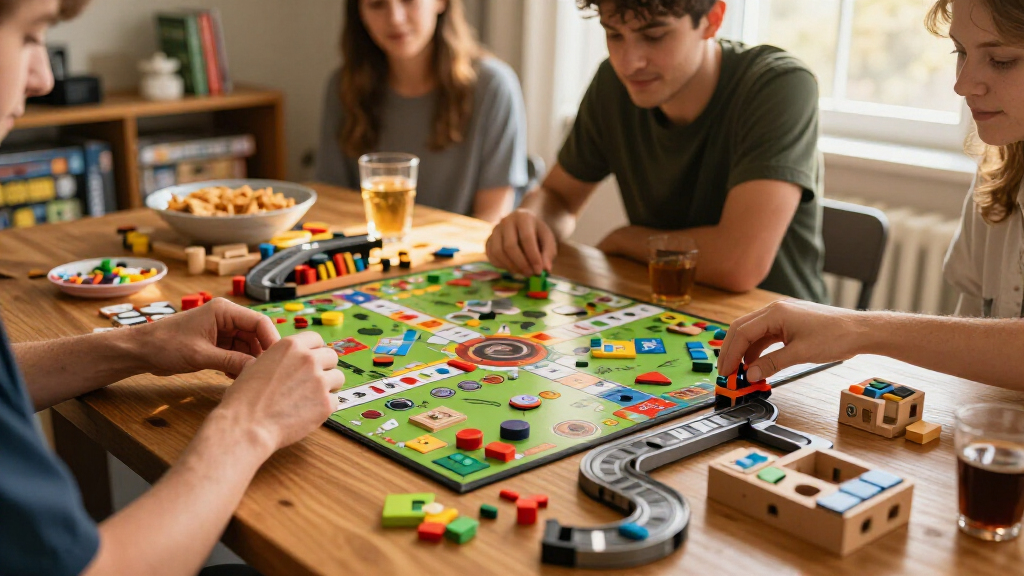

My picks for the best factory building board games split into three kinds of fun: designing an engine, solving a production puzzle, and racing to complete tasks. Fantastic Factories is my strongest choice for strategic dice placement and replayable planning, while Factory Funner puts machine layout and fast decisions at the center. For a shorter, approachable engine-building game, Little Factory is easier to bring to the table.

Play games on Amazon Luna for your game nights, included with Prime
- A rotating selection of games, no download needed
- Play on TV, laptop or phone
- Fast, free delivery for your gear, too
The tradeoff is that “factory” means different things across this lineup. Some games reward building an efficient production chain; others use factory work as a setting for tile placement, dexterity, or playful construction. I rank them by how directly their decisions capture building, arranging, or improving production, then weigh accessibility, player range, and pace. That means Monster Factory and HABA Fast Factory can be good family choices, but they are less focused on managing a productive factory than the top strategy picks.
Complete the kit


Key Takeaways
- Fantastic Factories is the best fit here for players who want dice placement, factory upgrades, and chained production decisions in one strategic game.
- Factory Funner makes spatial machine layout its central challenge and offers both real-time and turn-based play, though the real-time mode can feel hectic.
- Little Factory offers the most approachable resource-to-building engine among these picks, with a shorter play window than Fantastic Factories.
- Monster Factory is a creative tile-building family game; its factory connection is lighter than the production systems in the strategy titles.
- HABA Fast Factory is the dexterity and teamwork option for six players, but it focuses on assembly challenges rather than developing an economic engine.
| Fantastic Factories Board Game |  | Best Overall | Players: 1–5 | Estimated play time: About 60 minutes | Recommended age: 14+ | VIEW LATEST PRICE | See Our Full Breakdown |
| Factory Funner Board Game |  | Best for Spatial Factory Design | Players: 1–6 | Play time: 20–40 minutes | Game type: Factory-building board game | VIEW LATEST PRICE | See Our Full Breakdown |
| Little Factory – Resource Management & Engine Building Card Game |  | Best for Approachable Engine Building | Players: 2–4 | Playing time: About 30–45 minutes | Recommended age: 10+ | VIEW LATEST PRICE | See Our Full Breakdown |
| Monster Factory Board Game for 2–6 Players, Ages 5+ |  | Best for Creative Family Tile Building | Players: 2–6 | Estimated play time: About 30 minutes | Minimum age: 5+ | VIEW LATEST PRICE | See Our Full Breakdown |
| HABA Fast Factory – Robot-Themed Sequence Board Game for Kids 8 and Up |  | Best for Team Dexterity Challenges | Players: 6 | Minimum age: 8+ | Genre: Dexterity | VIEW LATEST PRICE | See Our Full Breakdown |
| factory building board game | Players | Genre |
|---|---|---|
| Fantastic Factories Board Game | 1–5 | Strategy |
| Factory Funner Board Game | 1–6 | — |
| Little Factory | 2–4 | — |
| Monster Factory Board Game for | 2–6 | Tactical |
| HABA Fast Factory | 6 | Dexterity |
More Details on Our Top Picks
Fantastic Factories Board Game
Fantastic Factories earns my top position because its production theme is tied to the decisions players make. Dice act as workers, and each turn asks you to allocate them across actions, develop factories, and chain effects toward manufacturing goods. That gives the game a satisfying planning problem: the value of a factory comes from how well it fits the workers and actions available to you. Compared with Little Factory, it offers a broader tactical puzzle and more strategic texture; compared with Factory Funner, it is less about snapping up a machine and more about managing a turn-by-turn production plan.
The game is described as easy to learn, with clear iconography and a short teaching time, but that does not make it a lightweight filler. Its 40-plus unique cards offer variety, and the reported play time of around an hour leaves room for players to develop their plans. Thick, double-layered boards add a practical touch for tracking a personal setup. Solo play and support for up to five players make it unusually flexible among the more strategic options here.
The main cost of that flexibility is time and attention. A session can approach an hour, which may be more commitment than a casual group wants, and players who dislike optimizing dice assignments may find the chained actions demanding. It also supports fewer than the six players allowed by Factory Funner and Monster Factory. I would pick it for a group that wants the strongest combination of factory development and repeatable strategic decisions, rather than the fastest or most playful interpretation of the theme.
Pros:- Dice placement makes worker allocation part of the factory puzzle.
- Factory actions can chain into satisfying production turns.
- Solo mode and support for up to five players broaden its use.
- A large set of unique cards supports varied sessions.
Cons:- Play can approach an hour, longer than the quicker picks here.
- Planning dice assignments and action chains may feel heavy for casual players.
Best for: Players who want a strategic production engine, solo mode, and enough card variety to revisit the game.
Not ideal for: Casual groups seeking a short, low-planning game or tables that need room for six players.
- Players:1–5
- Estimated play time:About 60 minutes
- Recommended age:14+
- Genre:Strategy
- Core mechanism:Dice placement and action chaining
- Solo mode:Yes
- Card variety:40+ unique cards
- Edition:Standard Edition
Our verdict“I recommend Fantastic Factories for the clearest blend of factory development, production planning, and strategic replay value in this lineup.”
Factory Funner Board Game
Factory Funner is my pick for players who want the factory floor itself to be the puzzle. Players grab machines and fit them into a layout, making quick spatial judgments about what will work together. The hex-based tiles give more room for inventive arrangements than the original Factory Fun, while refined scoring and placement rules sharpen the task. Compared with Fantastic Factories, this is a more immediate test of layout and reaction; it is less centered on building an engine through worker assignment and chained actions.
The real-time machine grabbing gives the game a distinct pulse. It can keep turns moving and discourage long pauses, which suits a group that enjoys quick choices. But speed changes the character of the decisions: a machine that looks useful at a glance may not fit your developing layout. For groups that want to plan calmly, the included non-real-time variant is a meaningful alternative, not just a footnote. Solo mode also makes it the only pick here besides Fantastic Factories with an expressly stated solo option.
Its 1–6 player range gives it an edge over Little Factory and Fantastic Factories when the group is large, and its stated 20–40 minute span makes it a brisker option than the latter. The tradeoff is that its signature pace can be stressful, and players who want a contemplative production strategy may prefer the dice puzzle in Fantastic Factories. I would rank it second because the factory layout is so direct and distinctive, while its real-time mode makes the fit more group-dependent.
Pros:- Machine placement makes factory layout central to play.
- Hex-based tiles allow creative arrangements.
- A non-real-time variant supports more deliberate groups.
- Solo mode and a range of up to six players cover varied tables.
Cons:- Real-time grabbing can feel hectic.
- Quick choices can lead to machines that fit poorly into a layout.
Best for: Players who enjoy spatial puzzles, fast decisions, and a factory layout that grows through machine placement.
Not ideal for: Players who dislike time pressure or want a slower, resource-focused engine-building game.
- Players:1–6
- Play time:20–40 minutes
- Game type:Factory-building board game
- Core activity:Real-time machine grabbing and placement
- Solo mode:Yes
- Alternative rules:Non-real-time variant included
- Tile shape:Hex-based
- Position in series:Sequel to Factory Fun
Our verdict“I would choose Factory Funner when arranging a working factory under pressure sounds more fun than managing a slower production engine.”
Little Factory – Resource Management & Engine Building Card Game
Little Factory turns resource trading into a compact building engine. Players begin with coins, trade among resources of increasing complexity, then construct buildings that improve acquisition and earn victory points. The loop gives the factory theme a clear purpose: early exchanges help establish the buildings that can make later turns more productive. Compared with Fantastic Factories, it is shorter and more accessible, with fewer layers of tactical decision-making; compared with Factory Funner, it is about developing an economic chain rather than fitting machines into a spatial layout.
That approachable structure is its strongest reason to make the list. A 2–4 player game lasting roughly 30–45 minutes is easier to propose on a weeknight than an hour-long strategy session. Fans of Little Town may also appreciate the shared universe and Sabrina Miramon’s illustrations. The stated victory condition, reaching 10 points, gives the engine a clear endpoint instead of letting the resource cycle continue indefinitely.
The limitation is depth. Experienced strategy players may want more interlocking systems than this title supplies, especially if they are choosing between it and Fantastic Factories. Listings also vary on whether a session takes around 30 or 45 minutes, so I would treat the stated range as a planning estimate rather than a fixed duration. I place it third because it delivers a focused, approachable factory-flavored engine, but its smaller player count and lighter decision space make it less versatile for larger or highly strategic groups.
Pros:- Trading resources and building structures form an intuitive engine.
- A shorter format is easier to fit into a casual game night.
- The 10-point goal gives play a clear finish line.
- Illustrations and shared setting may appeal to Little Town fans.
Cons:- The simpler gameplay may not satisfy experienced strategy players.
- Published play-time descriptions vary between roughly 30 and 45 minutes.
Best for: Newer engine-building players or fans of Little Town who want resource trading and construction in a shorter session.
Not ideal for: Experienced strategists seeking deep optimization or groups larger than four.
- Players:2–4
- Playing time:About 30–45 minutes
- Recommended age:10+
- Publisher:Iello Games
- Mechanics:Engine building, resource management, set collection
- Win condition:Reach 10 victory points
- Illustrator:Sabrina Miramon
- Related game universe:Little Town
Our verdict“I recommend Little Factory as the most approachable route into resource-driven factory building in this group.”
Monster Factory Board Game for 2–6 Players, Ages 5+
Monster Factory is the most playful construction game in this comparison. Players draw and place colorful tiles to create monsters, adding to their own constructions or challenging opponents. That makes it a family-friendly fit for children and adults who enjoy visual invention and tactical tile placement. Compared with Little Factory, there is little emphasis on trading resources into an economic engine; compared with Fantastic Factories, it offers a lighter, more creative building activity than a production puzzle.
The appeal is its accessible format. It supports two to six players and is described as taking about 30 minutes, so it can suit a family table or a group that wants a game with room for more people. The monster-building premise also gives players an immediate visual project to work on. Its “factory” connection is loose, though: buyers expecting to design efficient production lines or manage goods may find the theme label suggests a closer match than the actual play description indicates.
That difference explains its lower ranking. I include it for shoppers who mean construction and a factory-adjacent family theme, rather than an economic factory simulation. The provided specifications list no manufacturer warranty, which is a practical drawback but says little about gameplay itself. For a direct production experience, I would move up to Little Factory or Fantastic Factories; for creative tile assembly with a broad player count, Monster Factory has the clearer case.
Pros:- Tile placement supports imaginative monster construction.
- A broad two-to-six player range suits family gatherings.
- The stated 30-minute play time keeps sessions manageable.
- Simple family-oriented play can bring children and adults together.
Cons:- Its factory connection is lighter than the production systems in the top picks.
- The supplied specifications state that it has no manufacturer warranty.
Best for: Families with younger children who want a short, creative tile-laying game for up to six players.
Not ideal for: Players looking specifically for resource conversion, machine placement, or production-chain strategy.
- Players:2–6
- Estimated play time:About 30 minutes
- Minimum age:5+
- Brand:Rio Grande Games
- Genre:Tactical
- Core activity:Draw and place monster tiles
- Edition:Standard Edition
- Warranty:No manufacturer warranty listed
Our verdict“I would choose Monster Factory for creative family construction, while buyers seeking a true production engine should choose another title here.”
HABA Fast Factory – Robot-Themed Sequence Board Game for Kids 8 and Up
HABA Fast Factory makes factory work a hands-on race. Two teams play as assembly robots, moving, stacking, and nesting components to match tasks. Rather than building an economic engine like Little Factory, or composing a machine layout like Factory Funner, players coordinate physical actions against a challenge. The result is a more active family experience built around dexterity, logic, and teamwork.
The supplied components include two assembly lines, eight pieces in different shapes, a punch press, three golden tickets, and challenge cards described as offering 40 challenges across two difficulty levels. That progression gives families a way to start with simpler tasks and increase the challenge. The listing specifies six players, making it a natural option for a family group or two teams, while the wood and cardboard pieces reinforce the tactile style of play.
For the factory-building search, this is the most distant match in the lineup: players complete assembly challenges instead of designing a system that produces goods. Its appeal depends on wanting speed and hand coordination rather than the planning found in Fantastic Factories. The supplied listing also says it is limited to six players. I rank it fifth for factory simulation, but it may be the better pick for families who want a collaborative, physical activity that gets everyone involved rather than a seated strategy game.
Pros:- Team challenges combine movement, stacking, and nesting.
- Two difficulty levels give families a way to raise the challenge.
- Wood and cardboard pieces support hands-on play.
- The six-player format works naturally for team play.
Cons:- The assembly race is not an economic or engine-building factory game.
- The listed player count is fixed at six, limiting other group sizes.
Best for: Families with children aged eight and up who want team play, dexterity challenges, and a tactile activity.
Not ideal for: Strategy fans seeking resource management, factory layout planning, or solo play.
- Players:6
- Minimum age:8+
- Genre:Dexterity
- Material:Cardboard and wood
- Teams:Two
- Assembly lines:2
- Components:8 pieces, punch press, 3 golden tickets, rulebook
- Challenges:20 cards with 40 challenges across two difficulty levels
Our verdict“I recommend HABA Fast Factory for active family teamwork, while production-minded players will get a closer theme fit from the strategy titles.”

How We Picked
I compared these games against the promise of factory building: do players construct or arrange something, improve how it works, and make decisions that feel connected to production? I gave the most weight to games where planning a factory, managing resources, placing machines, or chaining output shapes the play. That favors Fantastic Factories, Factory Funner, and Little Factory for readers seeking an engine or production puzzle.
I also considered how each game fits a real table. Player count, stated play time, complexity, and alternative modes affect whether a game suits a quick family session, a solo puzzle, or a group that wants deeper planning. A game can earn a place here without being a close mechanical match: Monster Factory and HABA Fast Factory offer creative tile construction or hands-on assembly, respectively. I ranked them lower for factory simulation, while recognizing their distinct family appeal.
The descriptions and specifications supplied for these products are the basis for this comparison. I treat play times as approximate where listings or descriptions differ, and I do not infer unsupported component or rules details. The ranking is editorial: it reflects how directly each title serves buyers looking for factory construction, production choices, and the type of experience that best matches their group.
| factory building board game | Genre |
|---|---|
| Fantastic Factories Board Game | Strategy |
| Factory Funner Board Game | — |
| Little Factory | — |
| Monster Factory Board Game for | Tactical |
| HABA Fast Factory | Dexterity |
Factors to Consider When Choosing Best Factory Building Board Games
I would start by deciding what “factory building” means for your group. In this lineup, it can mean a production engine, a spatial machine puzzle, or a hands-on assembly challenge. That distinction matters more than the shared theme: the best match depends on whether players want to plan, react, or build something creative together.
Choose between engine building and machine layout
If you want a factory that grows more productive as you develop it, focus on Fantastic Factories and Little Factory. Fantastic Factories turns dice into workers and asks you to connect actions through factories and cards, giving strategic players more room to shape a plan. Little Factory uses resource trading and building construction for a more direct engine. I would choose the former for layered tactical choices and the latter for a lighter introduction.
Factory Funner approaches construction from the floor plan outward. Its challenge is finding a place for machines, with real-time grabbing adding urgency. That creates a different kind of satisfaction: spatial fit and quick evaluation matter more than nurturing an economic chain. If the word “factory” makes you think of arranging equipment, it may be the closest match; if you mean converting resources into goods, Fantastic Factories is stronger.
Match the pace to your table
The stated play-time estimates span from 20–40 minutes for Factory Funner to around an hour for Fantastic Factories. Little Factory and Monster Factory sit around the half-hour mark, though Little Factory listings vary between about 30 and 45 minutes. These are useful expectations rather than guarantees; group familiarity and pace can affect a session.
Time pressure is a separate question from duration. Factory Funner can move quickly because players grab machines in real time, but that speed may feel stressful. Its turn-based variant changes the feel for groups who want to pause and plan. Fantastic Factories takes longer but its pace comes from managing decisions, not racing against other players’ reactions. Pick the kind of pressure your group enjoys.
Check the player count and solo options
For solo play, the supplied details name Fantastic Factories and Factory Funner. For a six-player table, Monster Factory and Factory Funner support up to six, while HABA Fast Factory is listed specifically for six players in two teams. Little Factory tops out at four, and Fantastic Factories at five. Those limits can quickly narrow the field for a regular group.
Player count alone does not guarantee the right group experience. Monster Factory and HABA Fast Factory are the family-leaning options, but one focuses on tile-built monsters and the other on team dexterity. A large group looking for strategic production choices may find Factory Funner the closer fit. For a smaller strategy group, Fantastic Factories has the broadest stated range because it includes solo play.
Set the complexity level you want
Little Factory is the natural starting point if resource trading and constructing buildings sound appealing but you do not want a long strategy session. Its rules connect actions to a clear goal of reaching 10 points. Monster Factory is simpler in a different way: it emphasizes tile placement and creative construction, not production optimization.
Fantastic Factories offers more decisions through dice assignment, unique cards, and action chains, making it a better target for players who like planning several steps ahead. Factory Funner replaces some of that deliberation with quick spatial decisions. HABA Fast Factory uses dexterity and teamwork, so its challenge is coordination rather than strategic complexity. Matching complexity to the group means choosing the kind of thinking they enjoy, not simply choosing the game with fewer rules.
Decide how closely you want the theme to match
For the closest connection between factory theme and play, my order is Fantastic Factories, Factory Funner, then Little Factory. Each gives players a way to develop, arrange, or improve production. Monster Factory earns its place as a construction-themed family game, but the monster tiles are not a factory economy. HABA Fast Factory depicts assembly work through timed physical challenges, rather than factory design.
This distinction helps avoid buying for the title alone. If you want production chains, favor the top three. If you want a vivid group activity for children, Monster Factory or HABA Fast Factory may be a better night at the table, even though each is a looser fit for factory-building strategy.
Frequently Asked Questions
Which game is the closest match for factory building?
Fantastic Factories is my closest overall match because players develop factories and use dice as workers to chain production actions. Factory Funner is a close alternative if you care more about arranging machines in a workable layout than managing a production engine. Little Factory also connects resources and buildings, with a simpler structure.
Which option is best for beginners?
Little Factory is my pick for a beginner who wants resource management and engine building without the longer strategic session associated with Fantastic Factories. Families seeking a more playful introduction can look at Monster Factory, though it focuses on tile-built monsters rather than managing a factory. HABA Fast Factory is approachable through physical challenges, but it is a different kind of game.
Which games support solo play?
The supplied product descriptions explicitly list solo play for Fantastic Factories and Factory Funner. Fantastic Factories suits someone looking for a dice-placement production puzzle, while Factory Funner centers on machine placement and also includes a non-real-time variant. The provided details do not identify solo modes for the other three titles.
Which game works for a group of six?
Factory Funner and Monster Factory are listed for up to six players. HABA Fast Factory is listed for six players in two teams, so it suits that exact group size rather than offering a wider player range. Choose Factory Funner for machine-layout decisions, Monster Factory for family tile construction, or HABA for hands-on team challenges.
Are all five games strategy games about managing a factory?
No. Fantastic Factories, Factory Funner, and Little Factory most directly connect factory construction to production decisions. Monster Factory is a tactical tile game about building monsters, while HABA Fast Factory is a dexterity game about completing assembly tasks. I included those last two as family-oriented interpretations of construction and factory work, but buyers seeking economic planning should start with the first three.
Conclusion
For a strategic group or solo player, I recommend Fantastic Factories: its dice placement and production chains make factory development the heart of play. Choose Factory Funner if you prefer spatial machine layout, a brisker session, and the option to use turn-based rules. For a more approachable resource engine, Little Factory is the better starting point, especially for smaller groups.
Families who want creative tile construction can choose Monster Factory, while groups of six looking for active teamwork may prefer HABA Fast Factory. Those two are the loosest matches for a strategy-focused factory-building search, but their family play styles are distinct. My ranking favors production planning and factory design first, then lighter construction and assembly games for buyers whose priorities are accessibility, creativity, or physical play.
Halloween Picks
halloween
As an affiliate, we earn on qualifying purchases.