For most players, I’d start with the ASUS TUF Gaming VG27AQ3A: its 27-inch QHD resolution and 180Hz refresh rate balance sharpness and speed without pushing into specialist territory. The ASUS TUF VG27AQM5A is a stronger fit for competitive players seeking up to 300Hz, while the Sceptre C345B-QU240T pairs an expansive ultrawide canvas with a listed 240Hz refresh rate. The main tradeoff is that higher refresh rates, higher resolutions, larger screens, and ultrawide formats place different demands on your PC and your desk. I compared all 15 options by speed, image detail, panel format, and practical fit. Read on for the full breakdown and a pick for each kind of player.

Play games on Amazon Luna for your game nights, included with Prime
- A rotating selection of games, no download needed
- Play on TV, laptop or phone
- Fast, free delivery for your gear, too
Complete the kit

Key Takeaways
- QHD at 180Hz is the lineup’s best all-round balance: the ASUS TUF VG27AQ3A offers a useful mix of detail and speed, while the Acer Nitro KG271U and Samsung G51F options give shoppers other paths to the same broad performance tier.
- 300Hz is a specialist advantage, not a default upgrade: the ASUS TUF VG27AQM5A suits players with a PC that can feed high frame rates, but many players may prefer QHD detail over its speed-first emphasis.
- 240Hz appears across very different formats: options range from compact 24-inch FHD screens to a 34-inch 3440 x 1440 ultrawide, so the refresh-rate number alone does not tell you how demanding the display will be.
- Screen size and resolution need to be judged together: 32-inch FHD models prioritize a large image and high listed refresh rates, while 27-inch QHD models offer more pixel detail for desktop use and games.
- The roundup includes useful lower-speed and specialty alternatives: the 22-inch Sceptre with built-in speakers may suit a basic setup, while the Samsung OLED and curved ultrawides target buyers who value image character or immersion over a straightforward competitive setup.
| Samsung 34-Inch Odyssey G5 Ultra-Wide Curved Gaming Monitor |  | Best Ultrawide for Immersive Play | Screen size: 34 inches | Resolution: 3440 × 1440 | Aspect ratio: 21:9 | VIEW LATEST PRICE | See Our Full Breakdown |
| Samsung Odyssey G55C 32-Inch QHD 1000R Curved Gaming Monitor |  | Best Curved 32-Inch Value | Screen size: 32 inches | Resolution: 2560 × 1440 (QHD) | Aspect ratio: 16:9 | VIEW LATEST PRICE | See Our Full Breakdown |
| Acer Nitro KG271U 27-Inch QHD IPS Gaming Monitor, 180Hz | 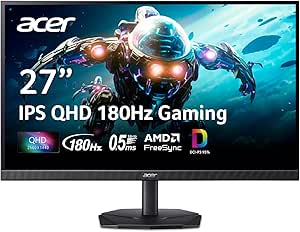 | Best Fast IPS All-Rounder | Screen size: 27 inches | Resolution: 2560 × 1440 (QHD) | Panel: IPS | VIEW LATEST PRICE | See Our Full Breakdown |
| Samsung Odyssey G5 G51F 32-Inch QHD 180Hz Gaming Monitor |  | Best Large-Screen 180Hz Pick | Screen size: 32 inches | Resolution: 2560 × 1440 (QHD) | Panel and finish: VA; matte | VIEW LATEST PRICE | See Our Full Breakdown |
| Samsung 27-Inch Odyssey OLED G5 QHD Gaming Monitor (G50SF) |  | Best OLED Motion and Contrast | Screen size: 27 inches | Resolution: 2560 × 1440 (QHD) | Panel technology: QD-OLED | VIEW LATEST PRICE | See Our Full Breakdown |
| SANSUI 32-Inch Curved 240Hz FHD Gaming Monitor |  | Best for Big-Screen 240Hz Gaming | Screen size: 32 inches | Resolution: 1920 × 1080 (Full HD) | Refresh rate: 240 Hz | VIEW LATEST PRICE | See Our Full Breakdown |
| ASUS TUF Gaming VG27AQ3A 27-Inch QHD 180Hz Gaming Monitor |  | Best QHD Balance | Screen size: 27 inches | Resolution: 2560 × 1440 (QHD) | Refresh rate: 180 Hz | VIEW LATEST PRICE | See Our Full Breakdown |
| ASUS TUF Gaming VG27AQM5A 27-Inch QHD 300Hz Fast IPS Monitor |  | Best for Maximum Refresh Rate | Screen size: 27 inches | Resolution: 2560 × 1440 (QHD) | Refresh rate: 300 Hz | VIEW LATEST PRICE | See Our Full Breakdown |
| SANSUI 27-Inch Curved FHD 240Hz Gaming Monitor |  | Best Compact Curved 240Hz Pick | Screen size: 27 inches | Resolution: 1920 × 1080 (Full HD) | Refresh rate: Up to 240 Hz | VIEW LATEST PRICE | See Our Full Breakdown |
| Sceptre 22-Inch FHD 144Hz Gaming Monitor with Built-In Speakers |  | Best Small-Desk Entry Pick | Screen size: 22 inches | Resolution: 1920 × 1080 (Full HD) | Refresh rate: Up to 144 Hz | VIEW LATEST PRICE | See Our Full Breakdown |
| Sceptre 24.5-Inch Curved Gaming Monitor, 1080p, 240Hz, 1ms, AMD FreeSync Premium |  | Best Compact Curved 240Hz Pick | Screen size: 24.5 inches | Resolution: 1920 × 1080 (Full HD) | Refresh rate: Up to 240Hz | VIEW LATEST PRICE | See Our Full Breakdown |
| Dell SE2426HG 24-Inch FHD 240Hz Gaming Monitor |  | Best Compact IPS Pick | Screen size: 23.8 inches | Resolution: 1920 × 1080 (FHD) | Refresh rate: 240Hz | VIEW LATEST PRICE | See Our Full Breakdown |
| Sceptre C345B-QU240T 34-Inch Curved Ultrawide Gaming Monitor, 3440 x 1440, 240Hz |  | Best Ultrawide High-Refresh Pick | Screen size: 34 inches | Resolution: 3440 × 1440 | Aspect ratio: 21:9 | VIEW LATEST PRICE | See Our Full Breakdown |
| Samsung 27-Inch Odyssey G5 G51F QHD Gaming Monitor |  | Best Ergonomic QHD Pick | Screen size: 27 inches | Resolution: 2560 × 1440 (QHD) | Refresh rate: 180Hz | VIEW LATEST PRICE | See Our Full Breakdown |
| AOC Q27G41ZE 27-Inch QHD 240Hz IPS Gaming Monitor |  | Best High-Refresh QHD Pick | Screen size: 27 inches | Panel type: IPS | Resolution: 2560 × 1440 (QHD) | VIEW LATEST PRICE | See Our Full Breakdown |
| gaming monitors with high refresh rate | Screen size | Resolution | Response time | Refresh rate |
|---|---|---|---|---|
| Samsung 34-Inch Odyssey G5 Ult | 34 inches | 3440 × 1440 | 1 ms MPRT | 165 Hz |
| Samsung Odyssey G55C 32-Inch Q | 32 inches | 2560 × 1440 (QHD) | 1 ms MPRT | 165 Hz |
| Acer Nitro KG271U 27-Inch QHD | 27 inches | 2560 × 1440 (QHD) | Up to 0.5 ms GTG | Up to 180 Hz |
| Samsung Odyssey G5 G51F 32-Inc | 32 inches | 2560 × 1440 (QHD) | 1 ms MPRT | 180 Hz |
| Samsung 27-Inch Odyssey OLED G | 27 inches | 2560 × 1440 (QHD) | 0.03 ms GTG | 180 Hz |
| SANSUI 32-Inch Curved 240Hz FH | 32 inches | 1920 × 1080 (Full HD) | 1 ms MPRT | 240 Hz |
| ASUS TUF Gaming VG27AQ3A 27-In | 27 inches | 2560 × 1440 (QHD) | 1 ms | 180 Hz |
| ASUS TUF Gaming VG27AQM5A 27-I | 27 inches | 2560 × 1440 (QHD) | 0.3 ms GTG (minimum) | 300 Hz |
| SANSUI 27-Inch Curved FHD 240H | 27 inches | 1920 × 1080 (Full HD) | 1 ms MPRT | Up to 240 Hz |
| Sceptre 22-Inch FHD 144Hz Gami | 22 inches | 1920 × 1080 (Full HD) | 1 ms | Up to 144 Hz |
| Sceptre 24.5-Inch Curved Gamin | 24.5 inches | 1920 × 1080 (Full HD) | 1ms | Up to 240Hz |
| Dell SE2426HG 24-Inch FHD 240H | 23.8 inches | 1920 × 1080 (FHD) | 0.5ms advertised; 5ms also listed | 240Hz |
| Sceptre C345B-QU240T 34-Inch C | 34 inches | 3440 × 1440 | 1ms | Up to 240Hz |
| Samsung 27-Inch Odyssey G5 G51 | 27 inches | 2560 × 1440 (QHD) | 1ms MPRT | 180Hz |
| AOC Q27G41ZE 27-Inch QHD 240Hz | 27 inches | 2560 × 1440 (QHD) | 0.3ms MPRT | — |
More Details on Our Top Picks
Samsung 34-Inch Odyssey G5 Ultra-Wide Curved Gaming Monitor
The 34-inch, 21:9 screen gives this Odyssey G5 a different appeal from the lineup’s standard 16:9 QHD monitors: supported games can fill more of your peripheral vision, while the 3440 × 1440 resolution preserves more detail than a typical ultrawide at this size. Its 165Hz refresh rate is lower than the 180Hz Acer Nitro KG271U and Samsung G5 G51F, but remains a strong fit for fluid play without making the wider format the sole priority. The 1000R curve wraps the image toward you, and FreeSync can help reduce tearing. Tradeoffs are its modest 250 cd/m² brightness and limited listed connections: one HDMI and one USB port. Choose it for immersion, not maximum refresh or bright-room viewing.
Pros:- 34-inch 21:9 QHD format offers a wider field of view than the 16:9 monitors here.
- 165Hz refresh rate and FreeSync support fluid, tear-reduced gameplay.
- Strong 1000R curve adds an enveloping feel at typical desk distance.
- HDR10 support and VA panel provide high-contrast image potential.
Cons:- 165Hz trails the 180Hz Acer Nitro KG271U and Samsung Odyssey G5 G51F.
- 250 cd/m² brightness may be limiting in bright rooms.
- Only one HDMI port and one USB port are listed.
Best for: PC gamers who want a wide, curved QHD view for supported racing, role-playing, and exploration games.
Not ideal for: Competitive players prioritizing the highest refresh rate in this group, or buyers who game in a bright room and need more listed brightness.
- Screen size:34 inches
- Resolution:3440 × 1440
- Aspect ratio:21:9
- Curvature:1000R
- Refresh rate:165 Hz
- Response time:1 ms MPRT
- Panel and sync:VA LCD; AMD FreeSync Premium
- Brightness:250 cd/m²
Our verdict“Pick this Odyssey G5 if a curved ultrawide view matters more to you than matching the lineup’s higher 180Hz options.”
Samsung Odyssey G55C 32-Inch QHD 1000R Curved Gaming Monitor
The Odyssey G55C brings a 32-inch QHD image and 1000R curve to players who want a large, immersive screen without moving to the 34-inch ultrawide format of the Samsung Odyssey G5. Its 165Hz refresh rate supports smooth motion, though it falls short of the 180Hz Acer Nitro KG271U and G5 G51F. That difference is modest for many players, but the Acer’s IPS panel and higher refresh make it a more direct choice for buyers focused on fast motion and broad color coverage. Here, HDR10, FreeSync, and eye-comfort modes round out the gaming feature set. The glossy finish may catch reflections, and the listed connectivity includes only one HDMI port. This makes more sense for a dimmer setup than a sunlit desk.
Pros:- 32-inch QHD display offers a larger image than the 27-inch Acer Nitro KG271U.
- 1000R curve gives the screen a more enveloping feel than the flat Samsung G5 G51F.
- 165Hz refresh and FreeSync support smooth, tear-reduced gameplay.
- Eye Saver Mode and flicker reduction are included for extended sessions.
Cons:- 165Hz is below the 180Hz refresh rates of the Acer Nitro KG271U and Samsung G5 G51F.
- Glossy finish can reflect bright room lighting.
- Only one HDMI port is listed.
Best for: Players who want a large, curved 16:9 QHD monitor for immersive single-player games and general PC gaming.
Not ideal for: Competitive gamers seeking 180Hz or above, or anyone whose screen faces windows or other strong light sources.
- Screen size:32 inches
- Resolution:2560 × 1440 (QHD)
- Aspect ratio:16:9
- Curvature:1000R
- Refresh rate:165 Hz
- Response time:1 ms MPRT
- Adaptive sync:AMD Radeon FreeSync
- Brightness and finish:300 cd/m²; glossy
Our verdict“Choose the G55C for a large curved QHD gaming view if 165Hz is enough and your room lighting is controlled.”
Acer Nitro KG271U 27-Inch QHD IPS Gaming Monitor, 180Hz
For a compact QHD setup, the Acer Nitro KG271U balances speed, resolution, and color better than the larger curved Samsung Odyssey G55C. Its 180Hz refresh rate edges past that model’s 165Hz, while the 27-inch IPS panel and stated 95% DCI-P3 gamut suit players who also care about colorful visuals. FreeSync helps reduce tearing, and the matte finish is less prone to reflections than the G55C’s glossy screen. The tradeoff is size: its 27-inch display feels less enveloping than either Samsung 32-inch option, and the 250 cd/m² brightness is modest. The up-to-0.5ms GTG response figure may depend on operating conditions, so it should not be treated as a guarantee of identical motion performance in every mode. Built-in speakers are convenient, but not a substitute for dedicated audio.
Pros:- 180Hz refresh rate is faster than the 165Hz Samsung Odyssey G55C.
- QHD IPS display and stated 95% DCI-P3 gamut suit detailed, colorful games.
- Matte finish helps limit reflections compared with the G55C’s glossy finish.
- Includes FreeSync, built-in speakers, tilt adjustment, and VESA mounting support.
Cons:- 27-inch screen is less immersive than the 32-inch Samsung G5 options.
- 250 cd/m² brightness may be underwhelming in bright rooms.
- Up-to-0.5ms GTG response time may depend on operating conditions.
Best for: QHD gamers with limited desk space who want 180Hz, an IPS panel, and broad stated color coverage for gaming and everyday use.
Not ideal for: Buyers who want a large curved screen, high room-light brightness, or a monitor whose advertised response figure they expect to hold across all settings.
- Screen size:27 inches
- Resolution:2560 × 1440 (QHD)
- Panel:IPS
- Refresh rate:Up to 180 Hz
- Response time:Up to 0.5 ms GTG
- Adaptive sync:AMD FreeSync
- Color gamut:95% DCI-P3
- Brightness and finish:250 cd/m²; matte
Our verdict“Choose the Acer if you want a 27-inch QHD IPS screen with 180Hz speed rather than a larger, more immersive curved display.”
Samsung Odyssey G5 G51F 32-Inch QHD 180Hz Gaming Monitor
The Odyssey G5 G51F pairs a 32-inch QHD screen with a 180Hz refresh rate, making it the larger flat-screen alternative to the 27-inch Acer Nitro KG271U. Both offer 180Hz, but this Samsung gives more screen area and a VA panel with a listed 3000:1 contrast ratio; the Acer counters with an IPS panel and 95% DCI-P3 color coverage. FreeSync and 1ms MPRT support responsive play, while Black Equalizer and Virtual Aim Point add game-focused visibility and aiming options. Its matte screen avoids the reflections possible on the curved G55C’s glossy finish. Unlike that model, the G51F is flat, so it gives up the wraparound effect of a 1000R curve. Connectivity is also spare, with one HDMI and one DisplayPort.
Pros:- 32-inch QHD screen runs at 180Hz, matching the Acer Nitro KG271U’s refresh rate on a larger display.
- 3000:1 listed contrast ratio and VA panel support more pronounced dark-light separation.
- Matte finish reduces reflections compared with the glossy Samsung Odyssey G55C.
- Height adjustment, tilt, FreeSync, Black Equalizer, and Virtual Aim Point add practical gaming features.
Cons:- Flat design lacks the curved immersion of the Samsung Odyssey G55C.
- One HDMI and one DisplayPort are listed, limiting direct device connections.
- The Acer Nitro KG271U offers IPS viewing and stated 95% DCI-P3 color coverage instead.
Best for: Players who want a large, flat QHD screen at 180Hz, plus a height-adjustable stand for a more flexible desk setup.
Not ideal for: Gamers who want a curved display, an IPS panel, or multiple HDMI connections for several devices.
- Screen size:32 inches
- Resolution:2560 × 1440 (QHD)
- Panel and finish:VA; matte
- Refresh rate:180 Hz
- Response time:1 ms MPRT
- Contrast ratio:3000:1
- Adaptive sync and HDR:AMD FreeSync; HDR10
- Stand and ports:Height adjustment and tilt; 1 HDMI, 1 DisplayPort
Our verdict“Pick the G51F if you want a spacious 32-inch QHD display at 180Hz and prefer a matte, adjustable flat screen over a curve.”
Samsung 27-Inch Odyssey OLED G5 QHD Gaming Monitor (G50SF)
The Odyssey OLED G5 G50SF is the image-quality specialist here: its QD-OLED panel combines QHD resolution, a listed 1,000,000:1 contrast ratio, and a 0.03ms GTG response time. At 180Hz, it matches the Samsung G5 G51F and Acer Nitro KG271U for refresh rate, but its OLED response figure and contrast set it apart from their VA and IPS panels. G-Sync compatibility and FreeSync support give it broad adaptive-sync flexibility, while the matte Glare Free finish helps with reflections. The tradeoffs are the 27-inch screen, a listed 280 cd/m² brightness, and just one HDMI port. OLED safeguards address burn-in risk but do not remove the need to weigh that technology’s suitability for long sessions with static desktop elements.
Pros:- QD-OLED panel and 1,000,000:1 listed contrast ratio distinguish it from the VA Samsung G5 G51F and IPS Acer Nitro KG271U.
- 0.03ms GTG response time and 180Hz refresh rate target fast, clear gameplay.
- Supports both NVIDIA G-Sync Compatible and AMD FreeSync.
- Matte Glare Free finish, OLED safeguards, and Auto Source Switch+ are included.
Cons:- At 27 inches, it is smaller than the 32-inch Samsung G5 G51F and Odyssey G55C.
- 280 cd/m² listed brightness may limit impact in bright rooms.
- Only one HDMI port is listed, and OLED safeguards do not eliminate burn-in concerns.
Best for: Players who prioritize OLED contrast, very fast stated pixel response, and QHD gaming at 180Hz on a 27-inch screen.
Not ideal for: Buyers who need a larger display, multiple HDMI connections, higher listed brightness, or a screen used for long stretches of static content.
- Screen size:27 inches
- Resolution:2560 × 1440 (QHD)
- Panel technology:QD-OLED
- Refresh rate:180 Hz
- Response time:0.03 ms GTG
- Contrast ratio:1,000,000:1
- Adaptive sync:NVIDIA G-Sync Compatible; AMD FreeSync
- Brightness and finish:280 cd/m²; matte Glare Free
Our verdict“Choose the OLED G5 if contrast and rapid pixel response matter more to you than a larger screen, extra HDMI ports, or higher listed brightness.”
SANSUI 32-Inch Curved 240Hz FHD Gaming Monitor
The 32-inch curved screen gives this SANSUI a larger, more enveloping view than the 27-inch SANSUI ES-G27C1 PRO, while both target players who want 240Hz Full HD motion without moving up to QHD. That refresh rate suits competitive games where quick updates matter, and FreeSync can help limit tearing when frame rates vary. The tradeoff is pixel density: 1920 × 1080 on 32 inches looks less sharp than the ASUS TUF VG27AQ3A’s QHD image, especially for text and fine details. Its 1500R curve may also be less appealing for work that calls for straight lines. The metal stand, tilt adjustment, and VESA mounting add setup flexibility, but there are no built-in speakers, so plan on headphones or external audio.
Pros:- 240Hz refresh rate suits fast-paced competitive play.
- 1500R curve creates a more surrounding view on the large panel.
- FreeSync support helps reduce tearing as frame rates fluctuate.
- Tilt adjustment and VESA mounting support flexible positioning.
Cons:- Full HD resolution is relatively coarse across a 32-inch display.
- No built-in speakers, so audio requires separate equipment.
- The large curved format is less suited to work requiring precise straight lines.
Best for: Competitive players who prefer a large, curved screen and prioritize 240Hz motion over sharper resolution.
Not ideal for: Players who sit close to the screen, want crisp text or detailed QHD visuals, or need built-in speakers.
- Screen size:32 inches
- Resolution:1920 × 1080 (Full HD)
- Refresh rate:240 Hz
- Response time:1 ms MPRT
- Curvature:1500R
- Contrast ratio:3500:1
- Adaptive sync:FreeSync
- Connectivity:HDMI, DisplayPort 1.4, 3.5 mm headphone jack
Our verdict“Choose this SANSUI if you want a large curved screen at 240Hz and can accept Full HD’s softer detail at 32 inches.”
ASUS TUF Gaming VG27AQ3A 27-Inch QHD 180Hz Gaming Monitor
The ASUS TUF VG27AQ3A is the balanced pick for players who want sharper QHD detail without giving up a high refresh rate. Its 180Hz Fast IPS panel is slower on paper than the 240Hz SANSUI ES-G27C1 PRO and well below the 300Hz VG27AQM5A, but 180Hz still gives responsive motion while 2560 × 1440 keeps game worlds and desktop text clearer than Full HD. ELMB Sync works alongside adaptive sync options to address blur and tearing, and the matte screen helps limit reflections. The tradeoff is a listed 1000:1 contrast ratio, which can make dark scenes look less deep than on higher-contrast alternatives. HDR10 support adds compatibility, not a replacement for a display built around stronger contrast. Built-in speakers are convenient, though they do not make this a dedicated audio setup.
Pros:- QHD resolution delivers finer detail than the Full HD SANSUI monitors.
- 180Hz refresh rate and 1ms response time support responsive gameplay.
- ELMB Sync and multiple adaptive-sync options address blur and tearing.
- Built-in speakers and HDMI, DisplayPort, and 3.5 mm audio provide practical connectivity.
Cons:- 180Hz trails the 240Hz SANSUI models and the 300Hz ASUS VG27AQM5A.
- The listed 1000:1 contrast ratio limits dark-scene depth.
- HDR10 support does not change the modest listed contrast ratio.
Best for: PC gamers who want a clear 27-inch QHD image, strong motion handling, and a refresh rate above standard 144Hz.
Not ideal for: Players chasing the highest refresh rates in this group or seeking deep, high-contrast HDR visuals.
- Screen size:27 inches
- Resolution:2560 × 1440 (QHD)
- Refresh rate:180 Hz
- Panel type:Fast IPS
- Response time:1 ms
- Adaptive sync:FreeSync Premium, G-SYNC Compatible, VESA AdaptiveSync
- Motion technology:ELMB Sync
- Connectivity:HDMI, DisplayPort, 3.5 mm audio
Our verdict“Pick the VG27AQ3A if QHD clarity and 180Hz responsiveness matter more to you than reaching 240Hz or 300Hz.”
ASUS TUF Gaming VG27AQM5A 27-Inch QHD 300Hz Fast IPS Monitor
For players specifically chasing a very high refresh rate at QHD, the ASUS TUF VG27AQM5A leads this group with 300Hz. That gives it a clear speed advantage over the 180Hz VG27AQ3A and the 240Hz SANSUI ES-G27C1 PRO, while keeping the more detailed 2560 × 1440 resolution those Full HD screens lack. Fast IPS, ELMB Sync, and FreeSync Premium support smooth, responsive play, though the listed 0.3ms GTG is a minimum specification, not a promise that every transition will perform that way. The extra refresh headroom makes the most sense with a PC able to deliver very high frame rates; otherwise, the less expensive performance target of 180Hz or 240Hz may be a better match. QHD also remains below 4K, and HDR support does not make it a 4K display.
Pros:- 300Hz refresh rate is the highest in this five-monitor batch.
- QHD resolution retains more detail than the 240Hz Full HD SANSUI models.
- Fast IPS, ELMB Sync, and FreeSync Premium support responsive, tear-reduced play.
- Built-in speakers and HDMI, DisplayPort, USB, and USB-C connectivity add flexibility.
Cons:- The 0.3ms GTG figure is a minimum specification, not a guarantee across all transitions.
- Getting full value from 300Hz calls for a PC capable of producing very high frame rates.
- QHD resolution is less detailed than 4K.
Best for: Competitive PC players with hardware capable of driving high frame rates who want QHD detail and refresh rates beyond 240Hz.
Not ideal for: Players whose systems cannot approach high frame rates, or buyers who prioritize 4K resolution over speed.
- Screen size:27 inches
- Resolution:2560 × 1440 (QHD)
- Refresh rate:300 Hz
- Panel technology:Fast IPS
- Response time:0.3 ms GTG (minimum)
- Color gamut:95% DCI-P3
- Adaptive sync:FreeSync Premium
- Connectivity:HDMI, DisplayPort, USB, USB Type-C
Our verdict“Choose the VG27AQM5A if your PC can feed it high frame rates and you want the fastest QHD option in this batch.”
SANSUI 27-Inch Curved FHD 240Hz Gaming Monitor
The SANSUI ES-G27C1 PRO keeps the 240Hz focus of its 32-inch sibling but fits it into a more manageable 27-inch curved format. Both SANSUI models use Full HD resolution and a 1500R curve; the smaller screen makes that resolution less stretched across a large viewing area, while the 32-inch version offers a more expansive image. Against the QHD ASUS TUF VG27AQ3A, this model gives up fine detail in favor of a higher refresh rate and a curved screen. FreeSync and 1ms MPRT support fast, tear-reduced motion, while the matte finish and low-blue-light features suit longer sessions. Its 130% sRGB and 95% DCI-P3 coverage are listed color specs, but HDR support alone does not establish HDR image quality. There are no built-in speakers.
Pros:- Up to 240Hz refresh rate targets fast-paced gaming.
- 27-inch Full HD panel spreads its pixels less widely than the 32-inch SANSUI.
- 1500R curve, matte finish, and anti-glare features support an immersive setup.
- FreeSync, tilt adjustment, and VESA mounting add practical gaming and placement options.
Cons:- Full HD offers less fine detail than the QHD ASUS TUF monitors.
- No built-in speakers.
- The curved screen is less suited to tasks where straight lines and flat geometry matter.
Best for: Competitive players seeking a compact curved 240Hz display who are comfortable gaming at Full HD.
Not ideal for: Buyers who want QHD sharpness, built-in audio, or a flat screen for productivity and precision work.
- Screen size:27 inches
- Resolution:1920 × 1080 (Full HD)
- Refresh rate:Up to 240 Hz
- Response time:1 ms MPRT
- Curvature:1500R
- Contrast ratio:4000:1
- Color gamut:130% sRGB; 95% DCI-P3
- Connectivity:HDMI, DisplayPort 1.4, 3.5 mm audio jack
Our verdict“Choose this model over the 32-inch SANSUI if you want 240Hz and a curved screen in a more compact Full HD size.”
Sceptre 22-Inch FHD 144Hz Gaming Monitor with Built-In Speakers
The Sceptre E225W-FW144G is the compact, lower-refresh option for a small desk or a first gaming setup. Its 144Hz ceiling is below the 180Hz ASUS TUF VG27AQ3A and far below the 240Hz SANSUI monitors, so it is not the choice for players prioritizing the highest motion rate in this roundup. Still, 144Hz with a listed 1ms response time offers a clear step up from conventional 60Hz screens, while Full HD is a sensible fit for its 22-inch size. Built-in speakers and Blue-Light Shift keep the setup simple, and the minimal bezels can help when pairing two displays. The tradeoff is limited screen area for immersive games or multitasking, plus only one HDMI port. FreeSync is included, but the product data does not specify its full adaptive-sync range.
Pros:- 144Hz refresh rate and 1ms response time provide a responsive step up from 60Hz.
- 22-inch Full HD format fits tighter desk spaces.
- Built-in speakers reduce the need for separate audio equipment.
- Minimal bezels support a cleaner dual-monitor arrangement.
Cons:- 144Hz is slower than every other monitor in this five-product batch.
- The 22-inch screen can feel cramped for immersive games or multitasking.
- Only one HDMI port is listed.
Best for: New PC gamers, students, or small-desk users who want a compact Full HD monitor with a refresh rate above 60Hz and built-in audio.
Not ideal for: Competitive players seeking 180Hz-plus motion or anyone who wants a larger screen for immersive gaming and multitasking.
- Screen size:22 inches
- Resolution:1920 × 1080 (Full HD)
- Refresh rate:Up to 144 Hz
- Response time:1 ms
- Adaptive sync:FreeSync
- Screen finish:Matte
- Ports:1 HDMI, DisplayPort
- Speakers:Built-in
Our verdict“Pick the Sceptre if desk space and a simple built-in-speaker setup matter more than matching the higher refresh rates of the other options.”
Sceptre 24.5-Inch Curved Gaming Monitor, 1080p, 240Hz, 1ms, AMD FreeSync Premium
This Sceptre pairs a 240Hz refresh rate with Full HD resolution in a compact 24.5-inch curved screen. That combination suits competitive players who want high frame rates without asking their graphics card to render QHD or ultrawide resolutions. Its 1500R curve adds a more enveloping feel than the flat Dell SE2426HG, while FreeSync Premium can help limit tearing when frame rates fluctuate. The tradeoff is that the Dell’s IPS panel and stated 99% sRGB coverage give it a clearer advantage for color-focused play and viewing from wider angles. Here, the 1ms response-time claim and built-in speakers are useful on paper, but Full HD gives you less desktop detail, and the listed color-gamut figure has no unit. Choose this for compact, fast gaming, not high-resolution visuals.
Pros:- Up to 240Hz refresh rate is suited to fast-moving competitive games.
- Full HD resolution is less demanding to render than QHD or ultrawide.
- 1500R curve and FreeSync Premium add immersion and adaptive-sync support.
- Built-in speakers and a blue-light filter provide convenient extras.
Cons:- Full HD resolution offers less detail and desktop space than the QHD Samsung Odyssey G5 G51F.
- The listed color-gamut value lacks a unit, making color coverage difficult to interpret.
- The curved design may be less suitable for buyers who prefer a flat screen.
Best for: Competitive players seeking a compact curved display that can pair Full HD with high frame rates.
Not ideal for: Players who want QHD detail, well-documented color coverage, or an IPS panel for color-sensitive work.
- Screen size:24.5 inches
- Resolution:1920 × 1080 (Full HD)
- Refresh rate:Up to 240Hz
- Response time:1ms
- Curvature:1500R
- Aspect ratio:16:9
- Adaptive sync:AMD FreeSync Premium
- Ports:2 HDMI, 2 DisplayPort
Our verdict“Choose this Sceptre if compact curved Full HD gaming at up to 240Hz matters more than QHD detail or clearly specified color coverage.”
Dell SE2426HG 24-Inch FHD 240Hz Gaming Monitor
The Dell SE2426HG is a compact choice for players who want 240Hz without a curved screen. Its fast IPS panel, 99% sRGB coverage, and 178-degree viewing angles make it more versatile for mixed gaming and everyday desktop use than the curved VA Sceptre C255B-FWT240. Both monitors top out at Full HD and 240Hz, so the Dell’s stronger case is panel type and stated color coverage, not extra resolution or speed. FreeSync Premium and HDMI VRR support smoother play when frame rates vary, while the matte screen and TÜV Rheinland eye-comfort certification suit longer sessions. There is some specification ambiguity: response time is advertised as 0.5ms but also listed as 5ms. Tilt is the only stated stand adjustment, so buyers needing height or pivot control may prefer the Samsung Odyssey G5 G51F.
Pros:- 240Hz refresh rate supports fluid motion in fast-paced games.
- IPS panel and 99% sRGB coverage suit gaming and general viewing.
- FreeSync Premium and HDMI VRR help reduce tearing.
- Matte finish and TÜV Rheinland 3-star eye-comfort certification add practical session-friendly features.
Cons:- Full HD resolution provides less detail than the QHD Samsung Odyssey G5 G51F.
- Response time is advertised as 0.5ms but also listed as 5ms.
- The stand offers tilt adjustment only.
Best for: Competitive players who want a compact flat IPS monitor for high-refresh gaming and general desktop use.
Not ideal for: Buyers who need QHD resolution, a fully adjustable stand, or an unambiguous response-time specification.
- Screen size:23.8 inches
- Resolution:1920 × 1080 (FHD)
- Refresh rate:240Hz
- Panel type:IPS
- Response time:0.5ms advertised; 5ms also listed
- Color coverage:99% sRGB
- Adaptive sync:AMD FreeSync Premium
- Ports:2 HDMI; DisplayPort 1.4
Our verdict“Pick the Dell for compact 240Hz IPS gaming and stated sRGB coverage, but skip it if you need QHD or broader stand adjustment.”
Sceptre C345B-QU240T 34-Inch Curved Ultrawide Gaming Monitor, 3440 x 1440, 240Hz
This Sceptre stands apart from the lineup by combining 3440 × 1440 ultrawide resolution with a refresh rate of up to 240Hz. The 21:9 format gives supported games and multitasking more horizontal room than the 16:9 AOC Q27G41ZE, while the 1500R curve is designed to keep that wide screen within a more enveloping view. Its 1ms response time, blur reduction, and Adaptive Sync are aimed at fast gameplay, and 100% sRGB coverage gives the visuals a clear color specification. The tradeoff is a much larger, more demanding display: driving QHD ultrawide at high frame rates asks more of a graphics card than Full HD on the compact Sceptre C255B-FWT240. Some games and desk setups may also suit 21:9 less well. Built-in speakers are convenient, but dedicated audio remains a better fit for buyers prioritizing sound.
Pros:- 3440 × 1440 resolution and 21:9 format provide a wide gaming and workspace view.
- Up to 240Hz refresh rate pairs high motion smoothness with ultrawide detail.
- 1500R curve, 1ms response time, and blur reduction target immersive, responsive play.
- 100% sRGB coverage and Adaptive Sync are specified.
Cons:- The ultrawide resolution demands more graphics performance than Full HD monitors in this lineup.
- The 21:9 format may not suit every game or desk setup.
- Built-in speakers may not satisfy buyers seeking dedicated gaming audio.
Best for: PC gamers with a capable graphics card who want an expansive curved screen for supported games and multitasking.
Not ideal for: Players with limited desk space, hardware aimed at Full HD high frame rates, or a preference for standard 16:9 compatibility.
- Screen size:34 inches
- Resolution:3440 × 1440
- Aspect ratio:21:9
- Refresh rate:Up to 240Hz
- Panel type:VA
- Response time:1ms
- Curvature:1500R
- Color coverage:100% sRGB
- Connectivity:2 HDMI, 2 DisplayPort, audio out
Our verdict“Choose this Sceptre for high-refresh ultrawide gaming if your PC and desk can accommodate its larger, more demanding format.”
Samsung 27-Inch Odyssey G5 G51F QHD Gaming Monitor
The Samsung Odyssey G5 G51F favors QHD detail and flexible positioning over the higher refresh rates offered by the 240Hz Dell and AOC. Its 27-inch, 2560 × 1440 panel gives games and desktop content more detail than either Full HD option, while 180Hz still provides a smooth step up from standard-refresh displays. The VA panel’s listed 3000:1 contrast ratio can help dark scenes appear more distinct, and FreeSync is intended to reduce tearing and stutter. A height-, pivot-, and tilt-adjustable stand is a practical advantage over the tilt-only AOC Q27G41ZE. The main compromise is speed: 180Hz is below the 240Hz monitors here, and its 1ms figure is specified as MPRT. HDR10 is included, but the listed 300 cd/m² brightness is a constraint for buyers seeking a brighter HDR presentation.
Pros:- QHD resolution delivers more detail than the Full HD Dell and Sceptre compact monitors.
- 180Hz refresh rate supports smooth gaming while balancing resolution and speed.
- VA panel lists a 3000:1 contrast ratio for pronounced dark-to-light separation.
- Stand adjusts for tilt, pivot, and height.
Cons:- Refresh rate is lower than the 240Hz Dell and AOC options.
- The 1ms response-time figure is specified as MPRT.
- Listed brightness is 300 cd/m², which may limit HDR impact.
Best for: Players who want QHD gaming at 180Hz, stronger listed contrast, and a stand with height and pivot adjustment.
Not ideal for: Competitive players prioritizing 240Hz or higher, or buyers seeking a particularly bright HDR display.
- Screen size:27 inches
- Resolution:2560 × 1440 (QHD)
- Refresh rate:180Hz
- Panel type:VA LCD
- Response time:1ms MPRT
- Contrast ratio:3000:1
- HDR:HDR10
- Adaptive sync:AMD FreeSync
- Stand adjustments:Tilt, pivot, and height
Our verdict“Pick the Samsung if QHD detail and ergonomic adjustment matter more to you than reaching 240Hz or above.”
AOC Q27G41ZE 27-Inch QHD 240Hz IPS Gaming Monitor
The AOC Q27G41ZE is the lineup’s clearest match for players who want QHD resolution and 240Hz together on a conventional 27-inch screen. Compared with the Samsung Odyssey G5 G51F, it raises the listed refresh rate from 180Hz to 240Hz and switches to an IPS panel, while both offer QHD at 27 inches. Its 240Hz native rate is already high; overclocking up to 260Hz is an extra option rather than the main reason to buy it. Adaptive-Sync and gaming tools such as Shadow Control add useful control over gameplay visibility. The compromises are practical: the stand only tilts, unlike the Samsung’s height and pivot adjustments, and the glossy finish may reflect bright room lighting. Its 0.3ms MPRT figure also describes a response-time mode, not a guarantee of every pixel transition.
Pros:- QHD resolution and native 240Hz refresh rate combine detail with fast motion.
- IPS panel offers a different viewing profile from the VA Samsung Odyssey G5 G51F.
- Adaptive-Sync and gaming tools such as Shadow Control support responsive play.
- Can be overclocked up to 260Hz.
Cons:- Stand adjustment is limited to tilt, unlike the Samsung Odyssey G5 G51F’s height and pivot options.
- Glossy screen finish may reflect bright room lighting.
- The 0.3ms response-time figure is MPRT and should not be read as a universal pixel-transition time.
Best for: Competitive PC players seeking a 27-inch QHD IPS screen with a native 240Hz refresh rate.
Not ideal for: Buyers who need a height-adjustable stand, game in a bright room with reflective lighting, or prioritize contrast over refresh rate.
- Screen size:27 inches
- Panel type:IPS
- Resolution:2560 × 1440 (QHD)
- Native refresh rate:240Hz
- Overclocked refresh rate:Up to 260Hz
- Response time:0.3ms MPRT
- Brightness:300 cd/m²
- Adaptive sync:Supported
- Ports:1 DisplayPort 1.4, 2 HDMI 2.0, audio out
Our verdict“Choose the AOC for QHD IPS gaming at a native 240Hz, provided its glossy screen and tilt-only stand fit your setup.”
How We Picked
I compared the monitors through the lens of high-refresh gaming, looking at listed refresh rate alongside resolution, screen size, panel type, and aspect ratio. A fast number matters most when the monitor’s resolution and format match the buyer’s PC, games, and desk. I also weighed practical usability: whether a model looks like a sensible first gaming display, a focused competitive screen, or a larger specialty choice.
The order favors balanced performance and broad fit over the highest refresh-rate figure alone. That places the ASUS TUF VG27AQ3A first for its QHD-and-180Hz balance, while the VG27AQM5A earns a more specialized role for 300Hz play and the 34-inch Sceptre ultrawide serves immersion-focused buyers. FHD models remain relevant for players prioritizing speed and a lighter resolution workload, but their lower pixel detail and, on some models, large screen size affect their placement. Where the supplied model details do not list a feature, I avoid treating it as a confirmed advantage.
Factors to Consider When Choosing Gaming Monitors With High Refresh Rates
I’d choose a high-refresh monitor by matching the display to the games and PC you actually have, rather than buying by refresh-rate number alone. These factors help separate a useful speed upgrade from one that adds demands or tradeoffs you may not want.
Match Refresh Rate to the Games You Play
A high refresh rate can make motion look smoother and inputs feel more immediate, but its value depends on the games you play and the frame rates your PC can produce. Competitive shooters often reward a speed-first display more than slower-paced or visually rich games do. A 300Hz screen is harder to take advantage of if your system rarely reaches frame rates near that level. Check whether the monitor supports variable refresh rate and confirm the supported range and connection requirements in its specifications. Don’t assume a fast panel alone removes tearing or stutter. If your frame rates vary, consistent performance may matter more than chasing the highest headline rate.
Choose Resolution With Screen Size and PC Capability
Resolution affects both image detail and the work your graphics card must do to produce high frame rates. QHD at 27 inches is a popular middle ground because it gives more desktop and game detail than FHD without the workload of a large 4K display. FHD can make sense for competitive play or a less powerful PC, but it looks less crisp when stretched across a larger screen. Before choosing a 32-inch FHD monitor, think about your viewing distance and how much fine text or game detail matters to you. A resolution upgrade can reduce frame rates, so check your system against the games you play rather than relying on a single benchmark. This tradeoff is especially relevant when comparing FHD 240Hz screens with QHD 180Hz options.
Treat Ultrawide as a Format Choice, Not Just a Size Upgrade
An ultrawide can widen supported games and provide room for multiple windows, but it changes more than the monitor’s physical footprint. Some games may not use the full aspect ratio, and competitive players may prefer a standard screen that keeps the whole action closer to the center. The 3440 x 1440 resolution also asks more of a graphics card than standard QHD, particularly when targeting high frame rates. Measure desk width and viewing distance before choosing a 34-inch curved model. Check game support and your preferred field of view, since a wider image is not automatically more useful. If you mainly play titles that do not benefit from ultrawide, a standard 27-inch display may be the more practical choice.
Understand Panel Type and Curvature Tradeoffs
Panel type affects motion handling, contrast, viewing angles, and the look of dark scenes, so refresh rate is only one part of the experience. IPS models are often selected for a balance of color and viewing angles, while OLED is appealing to buyers who prioritize contrast and dark-scene impact. OLED ownership can involve care considerations such as varied screen content and the manufacturer’s guidance on preventing image retention. Curved screens can make a wide display feel more enveloping, but the curve may be less useful on a smaller screen or for work that depends on straight lines. Look for the exact panel details rather than inferring them from a product family name. Decide which visual trait you value before paying for a panel type that does not help your games or setup.
Check Connections, Ergonomics, and Desk Fit
A monitor can list a high refresh rate yet require a particular input, cable, or settings combination to reach it. Check the manufacturer’s supported refresh rates by port and resolution, then confirm your graphics card has a matching connection. Consider height adjustment, tilt, VESA mounting, and cable placement if the product listing confirms them; these details affect daily comfort more than a small difference in refresh rate. A built-in speaker can cover basic sound needs, but it should not replace a headset or dedicated speakers if audio matters to you. Measure the stand’s footprint as well as the screen width, especially for curved and ultrawide models. These checks prevent a fast monitor from becoming an awkward fit or running below its advertised capability.
Spend More Only for a Benefit You Can Use
Paying for a faster refresh rate makes sense when your games, PC, and skill priorities can take advantage of it. A 300Hz display may suit a competitive player who consistently produces very high frame rates, while a QHD 180Hz model can be a better all-purpose choice for mixed gaming. An OLED or ultrawide is a different kind of upgrade: one prioritizes display character, the other a wider field of view and workspace. Avoid treating a larger number or more specialized format as an automatic improvement. Compare the full system cost too, since a higher-resolution monitor may prompt a graphics-card upgrade to maintain fast frame rates. Choose the feature that improves your actual use, not a specification you are unlikely to notice.
Frequently Asked Questions
Should I choose QHD at 180Hz or FHD at 240Hz?
I’d choose QHD at 180Hz if you want a sharper image for varied games, desktop use, and general PC tasks. FHD at 240Hz is a better match when competitive speed is your priority and your system can produce high frame rates at that resolution. The 240Hz figure does not automatically make the FHD screen better; it trades image detail for a higher refresh ceiling. Screen size also matters, since FHD can look less crisp on a larger display. Compare the games you play and your PC’s typical frame rates before deciding.
Is a 300Hz monitor worth choosing over a 240Hz model?
It can be worthwhile for competitive players whose PC can consistently deliver very high frame rates and who value small motion and responsiveness gains. If your frame rates stay well below 300, the extra refresh headroom may have limited practical value. A 240Hz model may offer a better fit if it provides a resolution, size, or format you prefer. Also check whether your games and connection support the monitor’s top refresh rate at your chosen resolution. I’d favor the display that better matches your whole setup over the biggest number.
Will a 34-inch 3440 x 1440 ultrawide work well for competitive games?
It can work well if you enjoy a broad view and your games support ultrawide resolutions, but it is not the safest choice for every competitive player. Some titles may limit the aspect ratio or handle the wider image differently, and a large screen can make it harder to keep all action in view. Rendering at 3440 x 1440 also puts more demand on your graphics card than standard QHD. Check the games you play and confirm the monitor’s connection can support its target refresh rate at full resolution. If speed and a compact field of view come first, a standard 24- or 27-inch model may suit you better.
Can my current PC run a high-refresh monitor at its maximum rate?
That depends on your graphics card, the game, the resolution, and the monitor’s input connections. A monitor’s maximum refresh rate does not mean your PC will produce the matching frame rate, especially at QHD or ultrawide resolutions. Check the monitor specifications for refresh-rate limits by port, then confirm that your graphics card has a compatible output and cable. Look at frame rates in the games you actually play rather than relying only on a peak result from a lighter game. Even when your PC cannot reach the maximum, variable refresh support may help, but verify the monitor’s specific support and range.
Is an OLED gaming monitor a better choice than a fast IPS model?
It depends on whether you value OLED’s display characteristics more than the practical tradeoffs of that panel type. OLED can appeal to players who care about contrast and dark-scene presentation, while a fast IPS model may be a more straightforward choice for mixed use. Compare resolution and refresh rate too; panel type does not tell you how well a monitor fits competitive play. Read the manufacturer’s guidance on care and image retention before choosing OLED for long sessions with static desktop elements. If your main goal is high refresh at QHD, compare the specific models’ speed and format rather than assuming one panel type wins for every player.
Conclusion
For the best overall fit, I’d choose the ASUS TUF Gaming VG27AQ3A: QHD and 180Hz make a balanced pairing for players who want both detail and speed. The best value-style choice by capability is the Acer Nitro KG271U if QHD and 180Hz meet your needs without requiring a higher-refresh specialist model. For the best premium, speed-focused pick, the ASUS TUF VG27AQM5A suits players who can make use of 300Hz; for a more immersive premium format, consider the Samsung OLED or Sceptre ultrawide, depending on whether contrast or screen width matters more to you. The best beginner-friendly direction is a standard 27-inch QHD 180Hz display, which avoids the extra format demands of ultrawide and the narrower use case of 300Hz. Choose a compact FHD 240Hz screen for a speed-first setup, a 22-inch Sceptre for a small, basic desk, or the 34-inch ultrawide when your games and desk can make use of the wider view.