
Shuffleboard strategy is subtle because it demands precise control over each shot’s speed, angle, and spin, requiring you to read surface conditions and adjust quickly. Every decision affects the score, so you must weigh risks and safety carefully. Small placement tweaks can change the entire game, making every move feel deliberate and careful. Mastering this delicate balance between attack and defense keeps the game challenging. If you continue exploring, you’ll uncover how these tiny choices shape winning tactics.
Key Takeaways
- Small score adjustments require precise shot placement and risk assessment to influence game outcomes subtly.
- Strategic decisions depend on real-time score, puck positioning, and surface conditions, demanding nuanced judgment.
- Mastery involves controlling puck speed, angle, and spin to execute delicate and impactful shots.
- Variations in table surface and imperfections necessitate adaptive tactics for optimal puck control.
- Subtle decision-making in shot execution can significantly alter game flow and advantage.

Have you ever wondered how seasoned shuffleboard players consistently outmaneuver their opponents? It’s not just about throwing the puck smoothly; it’s about understanding how subtle strategic decisions influence the game. Shuffleboard strategy is remarkably nuanced, relying heavily on score optimization and shot precision to gain the upper hand. You might think that power and aggression are the keys, but in reality, the most successful players excel at reading the table, adjusting their shots, and exploiting small openings. Every move is calculated, with an eye on how each shot alters the current score and the overall flow of the game.
Score optimization is essential because every point counts, and players who can subtly shift the scoring landscape hold an advantage. Instead of aiming for a perfect shot every time, you learn to weigh the risks and rewards of each placement. For example, if you’re ahead, you might play conservatively, aiming to block your opponent or keep your pucks in high-scoring zones, rather than going for risky shots that could open the door for your opponent. Conversely, if you’re trailing, you might need to take calculated risks, trying to knock opponents’ pucks out of scoring positions or create opportunities for your next shot. The subtlety lies in knowing when to play it safe and when to go for broke, adjusting your approach based on the current score and position on the board.
Smart players balance risk and safety, adjusting their shots based on score and position for strategic advantage.
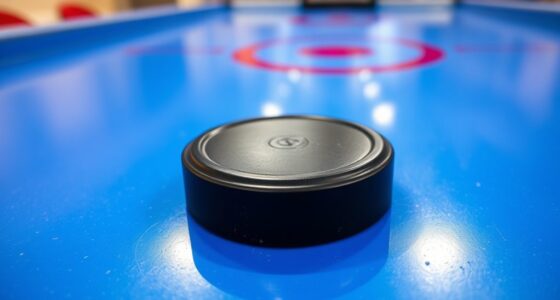
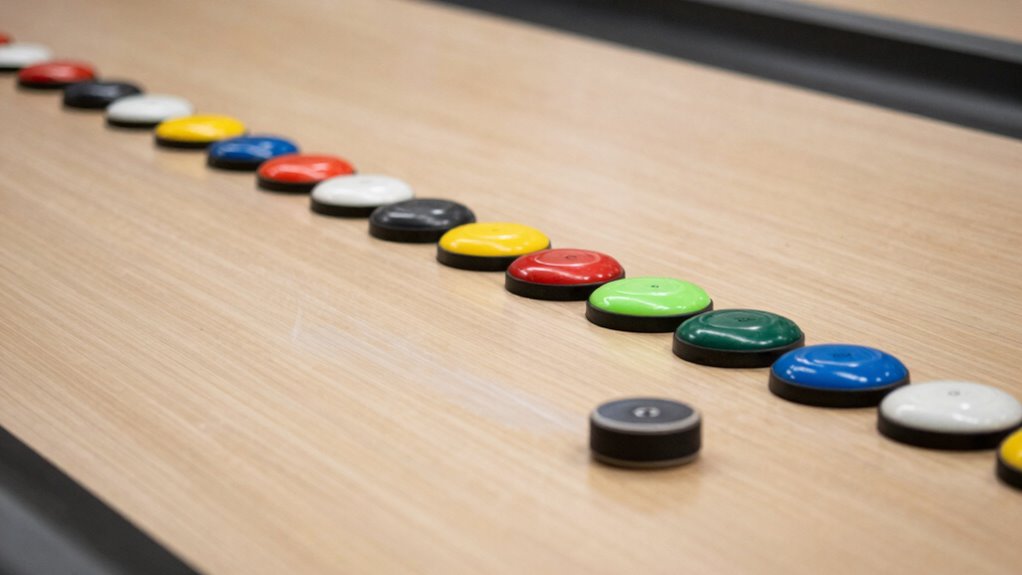
Shot precision is another critical element that makes shuffleboard strategy so refined. It’s not just about throwing the puck; it’s about controlling its speed, angle, and spin to achieve the desired placement. Precise shots often require delicate touches—sometimes just a gentle tap to nudge a puck into a more advantageous spot. Seasoned players develop a keen sense of how different techniques impact the puck’s trajectory and final resting place. They also pay close attention to the table’s surface, adjusting their shot to account for slight variations or imperfections that could affect the puck’s roll. Recognizing the importance of table surface conditions is crucial for mastering the game’s subtlety. Additionally, understanding how surface imperfections influence puck movement allows players to adapt their strategy accordingly, further emphasizing the importance of finesse in shuffleboard. A good understanding of surface conditions can also help players anticipate how the puck might react when it encounters different areas of the table, adding another layer of strategy.
Ultimately, shuffleboard strategy’s subtlety lies in the mastery of these small but impactful decisions. It’s about knowing when to be aggressive and when to be cautious, and executing each shot with pinpoint precision. It’s the combination of score optimization and shot control that transforms a simple game into a complex dance of tactics and skill. That’s why experienced players seem to read the table intuitively—because they’ve learned to appreciate the delicate balance of strategy that makes shuffleboard so intriguing.
shuffleboard pucks with spin control
As an affiliate, we earn on qualifying purchases.
As an affiliate, we earn on qualifying purchases.
Frequently Asked Questions
How Does Weather Affect Outdoor Shuffleboard Strategies?
Weather impact profoundly influences your outdoor shuffleboard strategies. Wind, rain, or sun can alter shot accuracy and puck movement. You need to adapt your equipment, like using heavier pucks for wind resistance or adjusting your grip to account for slick surfaces. By observing weather conditions and making quick equipment adaptations, you can maintain control and improve your chances of winning, even when the elements aren’t cooperating.
What Role Does Player Psychology Play in Shuffleboard Tactics?
Your player psychology considerably influences shuffleboard tactics. By maintaining a focused player mindset, you can stay calm under pressure and make precise shots. Psychological tactics, like visualizing success or staying positive, help you control nerves and adapt to changing game dynamics. Recognizing your mental state allows you to stay strategic, exploit opponents’ weaknesses, and make calculated decisions, ultimately giving you an edge in this subtle, mentally demanding game.
Are There Specific Strategies for Beginners Versus Advanced Players?
Yes, there are specific strategies for beginners versus advanced players. As a beginner, focus on basic shot selection and consistent player positioning to build accuracy. Advanced players, however, refine shot selection, aiming for strategic placements that block opponents or set up future shots. They also adjust player positioning based on game flow, making subtle tactical choices that require experience and keen observation to outmaneuver opponents effectively.
How Do Different Shuffleboard Court Surfaces Influence Strategy?
Court surface variations act like different personalities, shaping your strategy at every turn. Surface influence determines how the pucks slide—smooth surfaces make for fast, aggressive plays, while rougher ones demand precision and finesse. Knowing how each surface behaves helps you plan shots, whether you’re aiming for a soft touch or a bold strike. Adapting to these subtle differences keeps your game sharp and your tactics fresh, giving you an edge over your opponent.
Can Mirror Strategies Be Effective in Competitive Shuffleboard?
Mirror tactics can be effective in competitive shuffleboard because they involve deception strategies that keep your opponent guessing. By mimicking their moves or positioning, you create confusion, making it harder for them to predict your next shot. This subtle psychological play can give you an edge, especially in tight matches. Just make certain your mirror strategies are well-timed and natural, so they don’t appear obvious or disrupt your own game.
Conclusion
Mastering shuffleboard is like tuning a fine instrument—you need patience, precision, and a keen eye for nuance. Every shot is a whisper of strategy, subtly shaping the game’s melody. When you learn to read the board and anticipate your opponent’s moves, you’ll find that victory isn’t just about luck but about playing the game’s delicate dance with finesse. Embrace the subtle art, and let your skills turn each match into a symphony of skill and wit.